Facebook ads can put your firm in front of people who were not searching for an advisor today. Buying the ads does not mean those people will click, book, show up, or hire you.
Whether the spend helps depends on who sees the ad, what you say, where the click goes, and who follows up after.
Here's what to set up before you spend.
What Facebook ads can and can't do
A common line in wealth management is that Facebook is for consumer brands, not for advisors who want larger households. That is a slogan, not a decision.
The useful questions are simpler. Can you describe the people you want to reach? Can you give them a reason to take one next step? Can your team handle the replies? If the answer to the last one is no, the ads will create busywork.
Facebook ads interrupt people who were not necessarily looking for an advisor. Search ads more often meet people who already typed a question. Those are different jobs. Compare them with your own numbers, not with a story that one channel wins.
| Question to compare | Facebook and Instagram ads | Search ads |
|---|---|---|
| Who are you reaching? | People who may not have been looking for an advisor | People who typed a query |
| What must the first click do? | Give a reason to care right now | Match the thing they searched |
| What should you count on both? | Attended meetings and new clients from that path | Attended meetings and new clients from that path |
| What do you need in writing? | Media cost, tools, and who owns the account | Media cost, keywords, and who owns the account |
Use the same definitions on both sides. If one report counts form fills and the other counts meetings that happened, you are not comparing the same thing.
Ads also sit inside a larger system. If you want the wider picture of how conversations start, see lead generation for financial advisors. For who you are trying to reach, see how to attract high-net-worth clients.
I can't honestly tell you Facebook ads will produce better clients for your firm than another channel. That would take your market, your offer, and your follow-up, and I have not tested those. What I can do is show you the parts that usually decide whether the spend is even measurable.
Who should see the ads
Don't start by boosting a post to people interested in finance. That is too vague to learn from.
Before you build layers, check the campaign category in Ads Manager. For US ads that promote financial products or investment services, Meta may require the Financial products and services Special Ad Category. That category can limit or remove lookalike audiences, exclusion targeting, age, gender, postal codes, saved audiences, and some interests. Confirm the category and the filters you actually have. Write the plan around what the account allows, not around a targeting menu you saw in a generic tutorial.
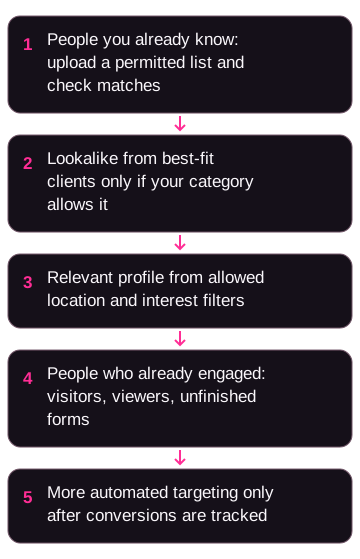
Build the audience in five layers, then write down what each layer is for.
People you already know. If your privacy policy and compliance team allow it, upload a client or prospect list so Meta can try to match emails, phone numbers, names, and locations. Check the match count you actually got. A messy list matches fewer people. If exclusion targeting is available for your campaign category, use a matched list to keep current clients out of prospecting ads when that is the goal. If it is not, keep prospecting and existing-client messages in separate campaigns you can control. If a lookalike option is actually available, you can also use a best-fit list as the seed.
People like your best-fit clients. A lookalike audience is Meta's attempt to find accounts that resemble a seed list. Quality of the seed matters more than dumping every contact you have. If a lookalike option is actually available for your campaign category, test one from best-fit clients. Build that seed from clients you actually want more of, not from every household in the CRM. Start narrower. Widen only after you have seen whether the first version leads to conversations worth having. If lookalikes are not available, skip this layer and use the allowed location and first-party lists instead.
People with a relevant profile. If your matched list is too small to be useful, you will lean on whatever location, age, and interest or job filters Ads Manager still offers. Stack a few allowed signals rather than betting on one. If Ads Manager still offers those filters for your campaign category, a stacked profile is clearer than age alone. If it does not, use the allowed location and first-party lists instead. Confirm which demographic and interest options are available in your ad account today. Labels change, and not every filter is allowed for every financial offer.
Treat the table below as a review list, not as a proven profile of high-net-worth households.
| What you are trying to do | What to check in Ads Manager |
|---|---|
| Stay inside your service area | Location and radius against the places you can actually serve |
| Reach people in your working ages | Age ranges, if Ads Manager still offers them for your category |
| Reach people who might have assets to invest | Whether income, home, or job filters are offered and allowed for your ads |
| Reach people already thinking about this | Interest or behavior options you can explain to compliance |
| Keep paying for the right people | Current clients, recent applicants, and anyone who asked to stop, using exclusions if available, or separate campaigns if not |
Ask your media buyer to show you the exact filters on the ad set, including what is excluded. If they cannot explain a layer, do not pay for it yet.
People who already engaged. Build separate audiences for site visitors, video viewers, people who opened a form and did not finish, and profile visitors if that option exists. Pick windows you can explain, such as the last 30 days, and write them down. Keep these out of the same ad set as cold prospecting so you can see what you pay for a new name versus a reminder.
More automated targeting. Meta also offers audience settings that let the system look beyond your filters. Use that as a later comparison against a list you understand, not as a replacement for knowing who you want. Automated targeting needs conversion history. If almost nothing is tracked yet, the system is guessing.
If a stacked audience barely delivers, you probably narrowed too far. If it is the size of a whole state and the messages are generic, you probably went too wide. Adjust one layer at a time so you can tell what changed.
What the ad should actually say
Most weak advisor ads look the same: a headshot, a logo, and 'schedule a free consultation.' That asks someone to talk about money with a stranger and gives them no reason to care.
You are not trying to win a design award. You are trying to earn one next step.
Say who it is for in the first line. Name a situation a real household would recognize. 'If you are within 10 years of retirement and still unsure how income will work, watch this' is clearer than 'we are a local wealth firm.'
Name the problem in ordinary language. Tax drag on a concentrated stock. Social Security timing they have not mapped. A portfolio conversation their current advisor has not had. Stay with issues you are actually allowed to discuss. Do not invent a scare.
Explain who you help, without performance theater. Credentials, the types of clients you serve, and the kind of planning work you do can belong here when they are true and approved. Specific returns, 'clients like you save $X,' and implied guarantees do not belong in the ad unless counsel has approved that exact line and the backup behind it.
Ask for one action. One. Do not promise a download, checklist, or emailed planner that you do not actually send. 'Book a 20-minute intro call' and 'answer a few questions to see if a conversation makes sense' are clear. 'Call us' is not.
Video is worth testing because you can say more than a still image. A still image can still be enough if the sentence is specific. Test both. Do not assume a format wins.
A useful talking-head outline, if you use video:
- First few seconds: the situation.
- Next: the problem, plainly.
- Then: why a conversation with your firm is relevant.
- Last: the single next step.
Keep it short enough that someone can finish it in a feed. A longer explanation can live on the page. A clear video in good light can be enough to start. Do not wait months for a studio if the delay is the real blocker. Test. Do not assume a casual video always beats a polished one.
One pattern that is easy to say out loud: talk about something you observed in work this week, in general terms, without exposing a client. 'I looked at three retirement-income plans this week and saw the same gap in all three' creates a reason to keep watching. It is still advertising. Get it reviewed. Do not treat a first-person hook as proof, and do not invent a story that did not happen.
If you use a longer video on the landing page, use the short ad to earn the click and the page video to answer objections. Then put a few questions in front of the calendar. The questions are what protect your time.
For the page that receives the click, see financial advisor website design that converts.
Where the click should go
The ad is the start of the process, not the result. A lot of 'Facebook doesn't work' reports are really 'we sent people to the homepage and hoped.'
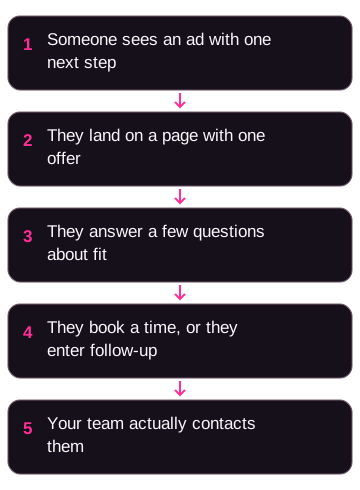
Walk one path on paper before you spend. These are five different steps:
- The person sees an ad.
- They land on a page with one offer and no extra navigation maze.
- They answer a few questions so you can see fit.
- They book a time, or they get a follow-up sequence if they are not ready.
- Your team actually contacts them.
Ask about investable assets, whether they already have an advisor, and the main problem they want help with, if your compliance reviewer accepts those questions. You are trying to keep the calendar for people you can serve. You are not trying to collect the maximum number of names.
Keep cold ads, reminder ads, and 'you started but did not finish' ads on separate lines so the budget does not all sit in one place. New people usually need a reason to care. People who already watched a video can be offered a clearer next step. People who opened a form and stopped may only need a reminder.
Write the split down before you launch. Keep most of the test budget for reaching new people. Keep a separate amount for people who already watched or visited. Keep a smaller amount for unfinished forms. None of those stages has a guaranteed conversion rate. The point is to count each step.
Leads who take a resource and do not book still need a follow-up plan. See email marketing for financial advisors.
How to test without starving the ads that still need data
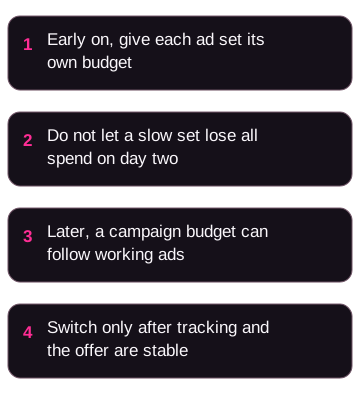
The budget setting most teams argue about is simple: does each ad set keep its own budget, or does the campaign move money toward whatever looks cheapest today?
Give each test its own budget at the start. If you let the system move all the money on day two, a slow ad set never gets a fair sample. You will not know whether it was bad, or just quiet. Equal daily amounts across the variants you actually care about is the cleaner test.
A practical starting shape: one campaign per objective, a few ad sets (one per audience you can explain), and two or three ads in each set. You do not need a dozen versions on day one. You need enough difference to learn which hook people will watch or click.
Let the campaign shift money later, once the offer is stable. When tracking is working and you have enough conversion events to learn from, a campaign-level budget can follow the audience that is producing the outcomes you set. Ask your buyer how many events they want before they make that switch. A lucky afternoon is not a strategy.
Confirm the current labels in Ads Manager. Meta renames settings. The decision is the same: fair tests first, automatic shifting after you trust the signal.
Don't copy a budget you saw in a blog table. You need a written media number you can keep for several weeks, plus time for follow-up. For where ads sit among other marketing costs, see financial advisor marketing cost.
Here is a made-up pacing example, not a recommended spend. $100 a day for 21 days is $2,100 in media cost. That only tells you the test was long enough to be inspected. It does not tell you how many leads, meetings, or clients you will get.
If you cannot keep spend steady for a few weeks, you are not testing the ads. You are sampling noise.
Tracking so you can tell if ads helped
If you cannot connect an ad to a page view, a form, a booked time, and a meeting that happened, you will argue about the ads from memory.
Before you launch:
- Put the Meta base pixel on the site and the landing pages, then verify events in Events Manager.
- Track page views, key service or article views, form submits, booking confirmations, and event signups as separate events if those actions exist.
- Turn on advanced matching if you are allowed to pass hashed email, phone, name, and postal code with the events. That can help Meta attach events to accounts. Check what your reviewer allows.
- Ask whether a server-side event setup can run next to the browser pixel, so you are not relying only on a browser that blocked the tag. In many setups this is labeled Conversions API. Confirm what your site and CRM can send today.
- Collect a way to follow up, such as an email, before the last booking step when that fits the offer. Otherwise you have no contact if they stop halfway.
Events Manager may show an event match-quality score for how well server events attach to accounts. Treat that as a setup health check. Ask your buyer what the score is and what they changed to improve it. It is not a promise that leads get cheaper if the number goes up.
Match booked calls in your CRM or calendar back to the campaign when you can. Advisor timelines are often longer than the ads report window. Check the attribution window in the account rather than assuming a default. Compare Meta's report with your own meeting log. If they disagree, believe the meetings you can name.
What to count after you spend
A cheap click is expensive if your team spends hours chasing someone who never meets with you.
Count, in order:
- Meetings that actually happened.
- New clients, and what it cost to get them, after the cost of serving them.
- Booked times that were no-shows.
- Qualified leads (your definition, written down).
- Cost per 1,000 impressions and cost per click, as delivery health checks.
Likes, comments, and click-through rate can tell you if the creative is being ignored. They cannot tell you if the spend paid for itself.
Here's the math with made-up numbers. This is an invented example, not a result from Facebook ads and not a forecast.
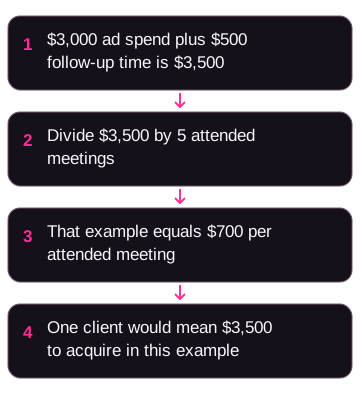
Assume $3,000 in ad spend in a month. Assume 10 hours of follow-up at $50 an hour, which is $500. Total cost is $3,500.
If 5 people attend a meeting, cost per attended meeting is $3,500 divided by 5, which is $700.
If 1 of those meetings becomes a client, acquisition cost in this example is $3,500 for that client, before the cost of serving them. If 0 become clients, you have spent $3,500 without new business yet.
For this example, the $3,000 includes all media fees. The $50 an hour is a stand-in for loaded staff time. Change every input. Keep the same definitions if you compare Facebook ads with Google Ads or with buying introductions.
Then keep going. How many of those meetings became clients? How long will their fees take to cover that cost, after the expense of serving them? The cost per meeting alone cannot tell you whether the spend paid off.
Do not turn assets under management into revenue, or revenue into profit. A household's investable assets are not your fee, and your fee is not what you keep.
Get each ad reviewed before it runs
Paid social is still advertising. It does not get a free pass because it runs inside Facebook or Instagram.
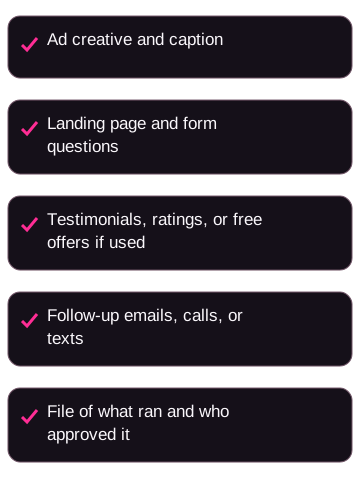
Have your compliance officer or outside counsel review the ad, the caption, the landing page, any testimonial, and the follow-up emails before you spend. I am not interpreting advertising law here, and this article is not legal advice. Your reviewer should use the official rules that apply to your firm. For SEC-registered advisers, that can include the Commission's marketing rule. For broker-dealers, that can include FINRA communications rules. Start with the official texts your counsel already uses, such as the SEC marketing rule adopting release and FINRA Rule 2210 when those apply.
Marketing choices that usually need a reviewer, not a guess:
- Specific returns, rankings, or 'you'll be better off by $X.'
- Client stories, video testimonials, ratings, and awards.
- Free reviews or assessments, and what the person actually receives.
- Any line that sounds like a result is likely or typical.
- How you collected permission to email, call, or text after the lead arrives.
Keep a file of the creative you ran, the dates, the audience, and the approval. When you change the hook, review it again.
Do not tell yourself the ads are approved because a blog checklist was short. Only your reviewer can accept the risk.
If an agency will run the ads for you
Don't assume every media buyer is offering the same thing. One proposal may include creative, landing pages, and compliance coordination. Another may only place ads in an account you already own. Ask for a current written proposal. Then get these answers in writing:
- Who owns the Facebook and Instagram ad account?
- Who owns the pixel, the audience lists, and the lead data?
- What is the total monthly cost, including media, tools, and management?
- What is the minimum term, the cancellation deadline, and what you can export if you stop?
- Who writes the ads, and who gets them reviewed before they go live?
- What counts as a qualified lead, and on what date will you review attended meetings together?
If those answers are vague, they will not get clearer after the invoice arrives. A cheaper management fee is not cheaper if you do not own the account or the data.
A first month you can actually run
Use this as a sequence, not as a promise that week four looks better than week one.
Week 1: make measurement real. Install and verify the pixel. Decide which events matter. Get a yes or no on list uploads, advanced matching, and server-side events. Write the audience plan: who you exclude, who you prospect, who you remind, and which Special Ad Category tools are actually available.
Week 2: build the path. Draft two or three ads with different hooks and the same offer. Build the landing page and the questions. Get compliance review. Set each test ad set its own budget. Create the reminder audiences, even if they start empty.
Week 3: launch and leave it alone. Pick a daily spend you can keep. Watch delivery (are ads spending, are people watching or clicking) without rewriting targeting every morning. If something is broken, such as a pixel that does not fire or a page that errors, fix the break. Do not optimize a two-day sample.
Week 4: inspect, then change one thing. Pause only what you can explain. Turn on reminder ads to people who watched or visited. Start the next creative so you are not stuck with one ad when people start seeing it on repeat. If tracking and the offer are stable, talk with your buyer about whether a campaign-level budget now makes sense.
For how this sits next to referrals, search, and other work, see how to get clients as a wealth manager and wealth management marketing strategies.
Mistakes that waste the budget
Launching before tracking is verified. If conversions are not firing, the system cannot aim at them, and you cannot judge the spend.
One ad for months. People tire of the same creative. Plan the next video or image before you need it. Frequency climbing on a cold audience is a hint to rotate, not a law with a magic number.
Sending traffic to the homepage. Too many links. Too many offers. No single next step.
Targeting so tightly the ads barely run. Relevance is useful. A tiny audience starves delivery. Broaden one filter if ads cannot spend.
Calling the test after a few days. Early costs are often ugly because the system is still learning and your page is untested. Agree on a review date and a budget before you start. A handful of unanswered calls is not a verdict.
Buying ads when follow-up is unmanned. Name the person who calls, emails, or texts, and give them hours on the calendar. If that person is already full, pause the ads until follow-up is real. Extra clicks will not create extra hours.
If you want people coming to your firm
Buying attention on Facebook is one option. Another is to build a path where someone finds your firm, learns how you work, answers a few questions, and asks for a conversation under your name.
That is the work we do at OJay Media: pages, ads, fit questions, and follow-up around your firm. Building it still takes time, money, testing, and someone to pick up the conversation. You can compare that with paid social, use both, or use neither until follow-up is real.
OJay Media is a marketing agency for wealth advisors. We have a commercial interest in that alternative. It is not the same product as boosting a post, it is not investment advice, and it is not a promise of clients.
If you are still choosing among channels, these are different jobs: referral marketing for wealth managers, LinkedIn for financial advisors, SEO for financial advisors, cold email for financial advisors, and choosing a marketing agency.
A few common questions
Do Facebook ads guarantee new clients?
No. You are paying for a chance to be seen and, if the path is built, a chance to talk. The person still has to choose you. Anyone who guarantees clients, revenue, or assets from ads is selling you a story you cannot take to your reviewer.
How much should a financial advisor spend on Facebook ads?
Spend an amount you can keep steady long enough to inspect meetings, not only clicks. Get the media cost, the tools, and any management fee in writing. A number you saw in an old article is not your budget.
What targeting should I start with?
Start by checking the campaign category in Ads Manager. If you advertise financial products or investment services to people in the US, Meta may require the Financial products and services Special Ad Category, which can limit or remove lookalikes, exclusion targeting, age, gender, postal codes, saved audiences, and some interests.
If you are allowed to upload a matched client list, start there. If exclusion targeting is available, use it to keep current clients out of prospecting ads. If it is not, keep prospecting and existing-client messages in separate campaigns. If a lookalike option is actually available, test one from best-fit clients. In parallel, test a stacked profile you can explain, using only filters that still appear. Keep reminder audiences separate. Add more automated targeting only after conversions are actually tracked.
Why are my financial services ads getting rejected?
Check whether the campaign is in the Financial products and services Special Ad Category if that applies, then read Meta's current financial products and services policy in Ads Manager. Common problems include promising results, targeting that uses restricted personal characteristics, and copy the automated review cannot classify. Have compliance look at the lines before you resubmit. If a legitimate ad is rejected, use the account's request-review path rather than swapping in stronger claims.
How long before I decide if Facebook ads are working?
Agree on a budget and a review date before you launch. Leave time for a click to become a conversation and a conversation to become a meeting. Check the contract if an agency is running this for you, including the minimum term. A week of high costs is not enough. Ninety days is not magic either. Review when you have enough attended meetings to judge the path, or when you can see a break (tracking, offer, or follow-up) that will not fix itself.
Can I just compare Facebook ads with the price of a lead?
Use price per lead as one line, then keep going. Include management fees, staff time, no-shows, and the meetings that happened. Then count clients. A cheaper lead that never attends is not cheaper.
More on finding clients
If you want the channel next to this one, start with Google Ads for financial advisors. If you want the system around the ads, start with lead generation for financial advisors. If follow-up is the gap, start with email marketing for financial advisors.