If you want wealthier clients, the first job is not a sharper pitch deck. It is a clearer answer to who you help, in what situation, and who you will not take on.
A careful prospect is not only comparing credentials. They are trying to tell whether your firm is built for someone in their position. If your site and your first call could belong to any wealth manager in town, they have no reason to believe you are the right one.
This article is about that filter. Not ad platforms. Not a promised number of introductions. The words, the public record, and the referral habits that make the right people opt in, and the wrong people opt out, before they take your calendar.
Key takeaways
- Make it easy for a careful prospect to judge fit before they book a call.
- "We help everyone with wealth" is easy to say and hard for the right person to trust.
- Your answer to who you work with is a positioning line, not small talk.
- Say how you get paid in plain language, then have compliance approve it.
- Other professionals refer you when it protects their reputation, not because you had lunch.
- None of this guarantees clients. It only makes it easier for the right people to recognize you.
Start with who you actually help
Before someone compares your process, they are asking a simpler question: is this the kind of advisor a person like me actually uses?
A list of designations will not answer that. Marks such as CFP or CFA tell them you cleared a bar many advisors clear. They still do not know whether you have sat with someone in their situation.
Look at the words a stranger can already see:
- Does the site show a specific type of person, or a silhouette labeled individuals and families?
- Does the content mention decisions those people are actually making, such as a business sale, concentrated stock, deferred compensation, or a family handoff?
- Could a prospect who is not a fit tell that this is not for them?
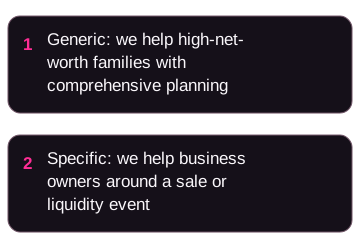
If you stayed generic so you would not exclude anyone, you also gave your best-fit client nothing to hold onto. Specific is not the same as rude. You can be warm and still be clear. A business owner heading into a liquidity event should recognize themselves faster than someone who wants a different kind of help.
Write the sentence from work you already do well. If you do not actually specialize in a situation, do not advertise that you do. A made-up niche is worse than a broad one.
Why comprehensive can push the right people away
The instinct is to look complete. More services. More life stages. More net-worth bands. That can feel safer because it keeps every door open.
To a person with a specific problem, comprehensive can sound like not specialized in my situation. A business owner with concentrated equity does not need a brochure that lists every service you could theoretically offer. They need to tell, quickly, whether you have guided people through the kind of liquidity event they are facing. A retired executive with deferred compensation does not need a slogan about complete wealth management. They need to tell whether you know that world.
Niche wording is not a promise that your market gets smaller. It is a way to occupy one clear place in the mind of the people you most want to speak with. The test is simple: can a prospect repeat, in one sentence, who you help and what situation you handle? If the honest answer is not really, your public wording is working against you.
Here is a made-up example of the cost of leaving that sentence vague. You spend 12 hours on a prospect who was never a fit: two calls, a follow-up, and a proposal. If you count that time at $250 an hour, that is $3,000 of time before you decline the work. Your hours and your rate will differ. These are invented figures, not a result from OJay or from any advisor. They are only here to show that unclear positioning spends time even when you never take the client.
Do not turn that time cost into a revenue forecast, and do not treat assets under management as income. The only point is that a wrong-fit conversation has a cost.
What they often check before the first call
By the time someone books a call, they may already have a working opinion. Treat that as likely, not as a research finding.
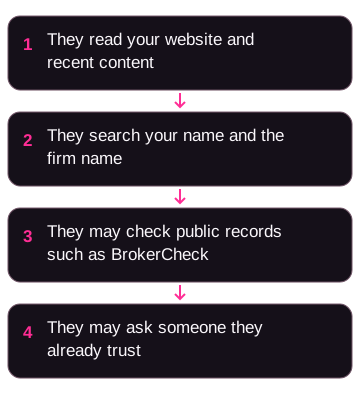
A careful person can:
- Read your website and a few pieces of content.
- Search your name and the firm name.
- Check public records such as BrokerCheck.
- Ask someone in their network what they have heard.
You do not control the network conversation. You do control whether the public material is specific, calm, and consistent. If the site says one thing and the first five minutes of the call say another, they will notice.
They will also listen for who you work with. "What kind of clients do you typically work with?" is not small talk. If the answer is broad, they can file you under generalist. If the answer names a real profile you serve, they can tell whether they are in the right room.
They will test for discretion too. Wealthy clients are often careful about how visible their situation is. If you mention other clients by name, even to compliment them, you teach the person in front of you how you talk about people when those people are not in the room.
What tends to push people away in that first conversation, as ordinary sales judgment rather than a study:
- Jumping into products before you understand why they reached out.
- Urgency language, such as a limited number of spots, when they asked a fit question.
- A long credential list with no sign you know their world.
- Discovery questions that could be asked of anyone with a checking account.
- Treating their situation as routine when they do not experience it that way.
Your answer to who you work with
This question shows up on first calls, in referral chats, and in how people describe you later. A vague answer trains them to file you under generalist.
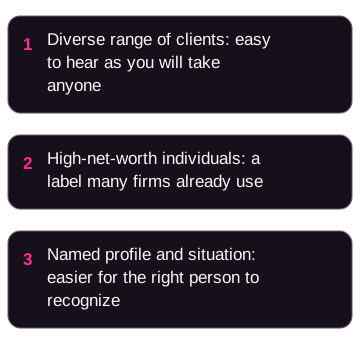
A weak answer sounds like this: "We work with a diverse range of clients from different backgrounds and stages of life." That tells a careful prospect almost nothing, except that you may take anyone.
A still-weak answer sounds like this: "We work with high-net-worth individuals and families." That is a category many firms already use. It does not tell them whether you know their situation.
A stronger answer, as an example of structure rather than a script you must copy, sounds like this: "We primarily work with business owners and senior executives. Most of them are in the years around a major liquidity event. They have built something substantial, and they want a partner who can handle the financial complexity without ignoring the personal side of what comes next."
If that is not your real book of business, do not say it. Name a wealth range only if it matches who you actually take on. Then let compliance review anything public that might imply a specialty you cannot support.
| Answer you give | What it can signal | How a careful prospect may hear it |
|---|---|---|
| We serve a diverse range of clients | You will take anyone | This is not built for me |
| High-net-worth individuals and families | A wealth label many firms use | I still cannot tell if you know my situation |
| Business owners around a liquidity event, in a range you actually serve | You repeat the same kind of work | I can tell if I belong here |
Spend real time on this answer. It is a short window, and people will repeat it when they introduce you.
Be clear about how you get paid
Do not assume wealthy prospects only care about a low fee, and do not assume they never care about cost. You cannot know their priorities in advance. What you can control is whether the explanation is easy to understand.
If a prospect has to hunt for how you are paid, that fog becomes part of the first impression. If you can say the fee, what it covers, and what it does not cover, they can at least compare you with someone else. Ask for compliance approval before any of that wording goes on a website, in a slide, or in a spoken script.
Have your reviewer look at:
- Whether fees belong on the website at all.
- The exact phrasing, including percentages, minimums, and what is not included.
- How you talk about commissions, revenue sharing, or the absence of them.
- Any comparison with other advisors.
Do not claim that an assets-under-management fee is always more aligned than another model. Explain the facts of your model. A prospect can only judge alignment from what you are willing to state. Do not promise that a given structure is compliant. That is a legal conclusion your firm has to own.
If you want a wider view of how this kind of wording sits next to outreach, see wealth management marketing strategies.
Signals that help, and ones that backfire
Some firms try to look expensive. Others try to look modest. Neither costume answers the fit question.
What tends to help, when it is true:
- A plain description of the people you already serve, without naming them.
- Content that walks through a real decision those people face, without fake case metrics.
- Public materials that look cared for. Sloppy pages make people guess about sloppy work.
- Proof you can actually point to, such as a talk you gave or an article you wrote, not a badge you cannot explain.
What tends to backfire:
- Leading with awards the prospect cannot verify.
- A first-conversation story so specific it sounds like you are repeating a client's private outcome.
- Name-dropping firms or people to impress someone who did not ask.
- Proof that sounds like a performance record, such as a tax-savings average, unless you can support it and compliance will stand behind it.
If you want a specific proof line, use something you can document without exposing a client, or do not use it. "We have helped business owners through sales" is a different claim from inventing a client count, a dollar range, and an average result. Do not manufacture that kind of number.
Referrals from other professionals are a different conversation
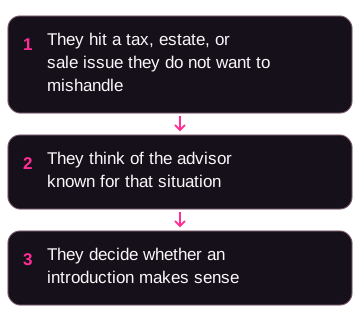
Client referrals still matter. Someone who already works with you can introduce a peer. At higher wealth levels, introductions also come from people whose own reputation is on the line: CPAs, estate attorneys, business brokers, and others who sit next to a messy financial moment.
Those people are not usually referring you because you are friendly. They are asking whether naming you will make them look careful or careless. Friendship can help you get the meeting with the CPA. It is not what makes them put their name on the introduction.
That changes what you send them. A lunch is not a positioning document. A short, anonymized summary of a situation they often see, what you did, and what you did not do, can be easier for them to remember. Strip names. Strip anything a client could recognize. Run it through compliance before it leaves your office.
Do not claim this is how most wealthy clients are won. Treat it as a different conversation from a friend-to-friend introduction, and build for that difference.
For a fuller referral system, see referral marketing for wealth managers.
What to tighten this week
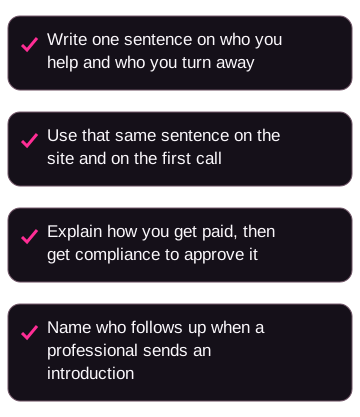
You do not need a new brand campaign to start. Work through these four checks.
- Write one sentence: who you help, in what situation, and who you point elsewhere.
- Put that sentence on the website where a stranger would look first, and say the same thing on the first call. Remove a competing line that says you help everyone.
- Decide how you explain fees in one pass, then get compliance to approve the wording.
- Name the person who follows up when a professional sends an introduction, and make sure they have time to do it.
If you also need a way for the right people to find you in the first place, lead generation for financial advisors covers turning this kind of positioning into a path people can actually enter. Ads, search, and a new sentence still do not guarantee clients. If nobody has time to follow up, fix that before you buy more attention.
If you want help building pages, ads, questions before a booking, and follow-up under your firm's name, that is the marketing work we do at OJay Media. We have a commercial interest in that option. Being easier to find does not replace being clear about who you serve.
A few common questions
What is the most common mistake when you want wealthier clients?
Trying to sound available to every investor above a dollar cutoff. The people you most want cannot tell whether you have handled their situation before. Lead with a specific person and a specific problem you actually handle. Turn other people away clearly enough that your best-fit client does not have to guess.
Should I put fees on the website?
Only with compliance approval. If you can describe how you get paid in a sentence a prospect can understand, that is often clearer than hiding the subject until the last meeting. A buried explanation can look like you are avoiding the question. That is a marketing observation, not a legal requirement, and it is not a claim that a published fee will win the work.
Does calling myself a fiduciary win the first meeting?
Do not treat a legal label as a marketing slogan. If your firm uses that language, have compliance approve when and how you say it. In the first conversation, it is usually clearer to explain how you get paid, what you will not sell, and who you turn away. The substance is easier to judge than the label. This article cannot tell you what the law requires.
How long until new positioning works?
Nobody can honestly give you a date. Watch the next ten conversations. Are people self-selecting in or out more clearly? Are referral partners repeating the same one-sentence description? If those are not changing, the public wording still is not specific enough. Do not wait on a search ranking, an ad account, or a promised timeline to tell you whether the sentence is doing its job.
OJay Media is a marketing agency for wealth advisors. This article is about marketing choices. It is not investment, legal, tax, or compliance advice. Advisors remain responsible for their own advertising review. Have your firm's compliance reviewer approve website copy, fee language, examples, and anything you send to prospects or referral partners. Past marketing work is not a guarantee of future clients.
If the next conversation still sounds like it could be about anyone, rewrite the sentence until a stranger could repeat who you are for. Then make sure that line is true in public and in the room.