Cold email is worth trying when you can describe a business audience, find those people by title and company, and write about a problem they might actually have. It will not create clients on its own. Someone still has to reply, talk, show up, and choose to work with you.
Have your compliance reviewer read every template before you send anything. This is marketing-operations guidance for advisory firms, not legal, compliance, or investment advice.
Key takeaways
- Use cold email for a named business audience you can describe. If people usually find you through search, put your energy into lead generation for financial advisors instead.
- Build the list first. A decent note to the wrong person still goes nowhere.
- Send from a dedicated domain. Keep your main domain for clients and the mail they already expect from you.
- Keep the note short, specific, and free of performance claims unless compliance has approved that wording.
- Get a current quote from list tools and sending tools. Don't budget from an old price table.
- Count replies, conversations, attended meetings, and new clients separately. Sends are not results.
When cold email is worth testing
If you think of cold email as spam, you are thinking of a blast to people you cannot describe. That version is a bad fit for an advisory firm.
The useful version is narrower: you know who you want, you can find them by name, and you have something specific to say.
Example audiences you might test, if they match who you actually serve:
- Business owners who may be thinking about a sale, succession, or what happens to the company if they step back
- Physicians and dentists with concentrated income and little time
- CPAs and estate attorneys, as referral partners, not as AUM prospects
- Executives dealing with equity compensation, deferred compensation, or a large position in one stock
- Real estate investors who may be facing a sale, a 1031 deadline, or several entities
Those are targeting examples, not a ranked list of best niches. If you cannot say who the email is for in one sentence, you are not ready to send.
If your typical client is someone who searched, read, and then reached out, cold email is the wrong first bet. Start with lead generation and the pages that support it.
Referral-partner email is a different job from prospect email. You are proposing a professional relationship, not opening an account. See referral marketing for wealth managers for that path.
Build a list of named people, not a pile of addresses
The list is the campaign. If the names are wrong, the copy cannot save it.
Common B2B data tools to compare for this work include Apollo.io, ZoomInfo, Clay, and Hunter.io. They are not interchangeable, and I cannot honestly tell you which one is more accurate for your filters. Ask each vendor:
- What titles, industries, locations, and company-size filters you can actually use
- How they source and verify email addresses
- What you receive when a record is wrong or duplicated
- What a current contract costs, including seats and credits
Ask each vendor whether your use is a domain lookup, a large list pull, or combining sources. Confirm each of those on a current demo. Product pages change.
A practical way to build the list:
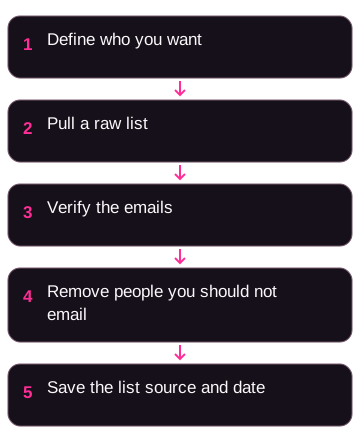
- Write down at least five filters: title, geography, industry, company size, and one business trigger. A trigger example: founded 5-10 years ago, if you want owners who may be closer to a transition. That is a hypothesis, not proof that they will sell.
- Pull a raw list. Start with a list you can actually check. A smaller clean list is easier to verify than a huge dump you never look at.
- Verify emails with a verification service before you import. NeverBounce and ZeroBounce are examples to compare. Get current pricing and what they actually check.
- Remove current clients, people already in a live conversation, and anyone your compliance team has on a do-not-contact list.
- Save the list source and the date you pulled it. Your reviewer may want that later.
High bounce rates can hurt whether future mail gets delivered. If bounces jump after you start, stop and clean the list before you send more.
For how this sits next to other channels, see lead generation for financial advisors.
Send from a dedicated domain, and start small
Do not run cold outreach from your primary firm domain. If those messages get filtered or marked as spam, you can damage the domain you use with clients.
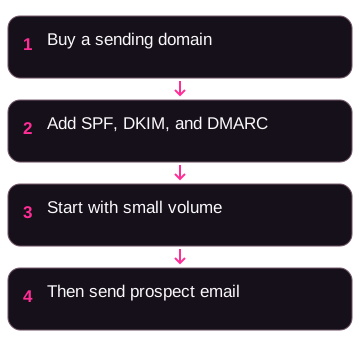
Buy a sending domain that is obviously related to you but is not the one on your letterhead. Set up authentication so receiving servers can tell the mail is really from you:
- SPF says which servers may send mail for that domain
- DKIM signs the message so it is harder to tamper with
- DMARC tells receiving servers how to treat mail that fails those checks
Your sending tool should show whether those records are live. Have whoever manages your DNS confirm them. Ask that person which DMARC policy to start with. Don't guess.
A brand-new domain has no sending history. A large first-day blast is a common way to land in spam. If your vendor offers a warmup feature, use it. Start with small volume and raise it only if bounces and complaints stay low.
Here is a made-up example, not a rule and not a result. One new inbox sends 25 emails a day in week one. If nothing looks wrong, it moves toward 50 a day later. If you want more volume, add inboxes and sending domains instead of forcing everything through one new mailbox. Ask your vendor what they recommend for your setup.
Sends, replies, and meetings are still different counts. Reaching the inbox is not a booked call.
Write a short email about their situation
The subject line has one job: look like a note from a person to a person. It does not need to sell the firm.
Patterns you can try:
- Question about [Company Name]
- [First name], quick question
- Exit planning for [industry] owners
- Running a [city] dental practice
Only mention a mutual connection if that is true.
Skip subject lines that sound like a brochure, such as Are you maximizing your wealth strategy? Skip fake reply threads such as Re: our call when there was no call. Skip all-caps and a pile of punctuation.
Keep the body short enough to read on a phone. One idea. One ask. The first email is trying to start a conversation, not close a client.
Leave out performance, testimonials, and lines about saving someone money unless your compliance reviewer has approved that exact wording. If the sentence only works because it implies a result, cut it.
Three starting frameworks. Swap in real details. Don't send them as-is if they don't match who you are. These are templates for your firm to adapt. They are not a description of OJay's clients or results. Only claim a specialty, a city, or a client base if that is true for you.
A short problem note (owners)
Subject: Exit planning for [industry] owners
Hi [First Name],
I work with [industry] owners in [city or region] who are a few years away from a possible sale and want the personal planning mapped before the deal gets real.
If that is on your mind at all, would a short overview of how we approach it be useful?
[Your name] [Firm] | [Phone] [Physical mailing address your reviewer has approved]
A research opener (when the account is worth the extra minutes)
Subject: Question about [Company Name]
Hi [First Name],
I saw [specific public detail: a hire, a location, a post] and wanted to ask about [Company Name].
As companies grow, equity compensation and concentrated stock can outpace a generic planning setup. If that is on your plate, would a 15-minute call be useful?
[Your name]
A referral-partner note (CPA or attorney)
Subject: Intro, [Your Firm] and [Their Firm]
Hi [First Name],
I'm [Name] at [Firm]. We focus on planning for [niche]. [Their Firm] looks like it serves a similar group.
Some of our clients need a strong CPA (or attorney) relationship, and I wanted to see whether a mutual introduction makes sense.
Would a 20-minute intro call work this week?
[Your name]
If you cannot name a real detail, you are not in the research template. Use the shorter note or skip the send.
Plan a sequence, not a one-off
One email is easy to miss. A short sequence gives people more than one chance to see a relevant note. I cannot tell you which touch gets the reply. Track that in your own data.
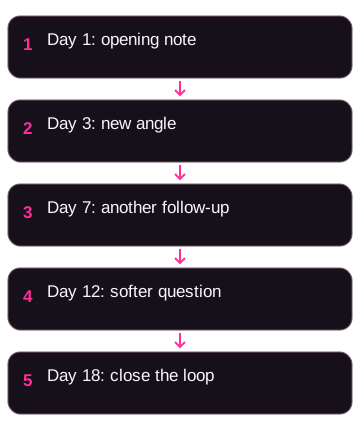
Here is an example five-email cadence you can adapt. Change the days if your process needs it.
- Day 1: opening note. State the situation and ask for a small next step.
- Day 3: follow-up. Add a new angle, not a bump with no new information.
- Day 7: another follow-up. Stay on their problem. Do not paste a case study unless compliance has approved it.
- Day 12: a softer question. Make it easy to say no or not now.
- Day 18: close the loop. Say you will stop, and leave a clean way to come back.
Example follow-up (day 3):
Hi [First Name],
Following up on my note.
If a sale or succession is even a maybe in the next few years, would it help to talk through the personal planning questions that usually sit next to the business deal?
[Your name]
Example close-the-loop note (day 18):
Hi [First Name],
I'll stop after this. I know the inbox is full.
If exit planning or tax-aware growth becomes a priority, you can reach me here.
[Your name]
Honor unsubscribes immediately. A sequence is not a reason to keep mailing someone who asked you to stop.
Have compliance review the copy before you send
Do not treat a blog post as sign-off.
In the United States, commercial email is regulated. Read the FTC CAN-SPAM guide for business with your reviewer. Ask what every send must include. Honor opt-outs. Ask your reviewer what else your firm requires. This paragraph is not a complete legal checklist.
If you are an RIA, ask your reviewer whether outbound mail is treated as advertising. Read the SEC Marketing Rule adopting release with your reviewer. As a drafting habit, keep testimonials, endorsements, and performance out of cold email unless that exact copy has been approved. Lines such as clients like you and we helped an owner save money are the kind to flag.
If you are with a broker-dealer, ask your principal what review you need before you scale. Ask your principal whether FINRA Rule 2210 applies to your sequence.
Do not buy a consumer email list and hope it is fine because a vendor sold it to you. Stick to a defined business audience you can explain, and have compliance look at the source as well as the copy.
The checklist in email marketing for financial advisors is a useful companion for the messages you send after someone has a relationship with you. Cold outbound still needs its own review.
Compare tools on a current quote, not a blog table
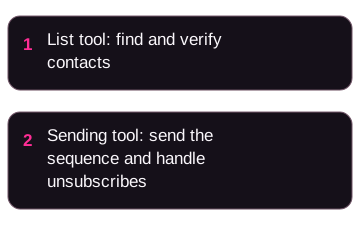
The sending tool affects authentication help, warmup, sequencing, unsubscribe handling, and reporting. The list tool affects who you can find. Compare them as two jobs, not as one blended score.
Sending tools to put on the same comparison include Smartlead, Instantly.ai, Lemlist, and Apollo.io. Ask each of them, on a current call:
- How they help you authenticate and warm a domain
- How many inboxes and domains you can run
- How unsubscribe and bounce handling works
- What reporting you get for replies versus automatic out-of-office mail
- The full price for the volume you actually want, including extra inboxes
I am not ranking these products. Features and prices change. Get the demo using the kind of list you would actually send.
For list tools, ask the same style of question about data coverage, verification, bad-record handling, and contract cost. A cheap pull that bounces is not cheap.
If nobody on your team has time to write the notes, handle replies, and book meetings, fix that before you buy more contacts. Extra names will not add hours to the day.
Count the work, not just the sends
Opens can hint that mail is getting through. They are not meetings. Replies are not clients.
Track at least:
- Emails sent
- Bounces and unsubscribes
- Replies (interested, not now, no)
- Conversations that actually happened
- Meetings that were attended
- Clients, if any, and what it cost to get them there
Use the same definitions for the whole test. Otherwise you will compare two different things.
Here is the math with made-up numbers. It is not a result from an advisor campaign, and it is not a vendor's price.
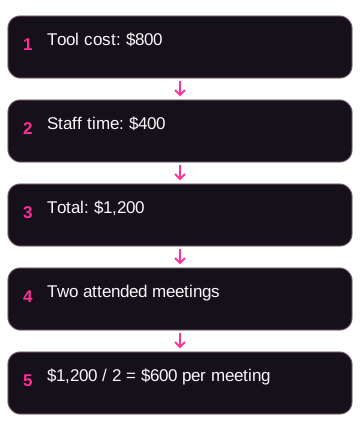
You spend $800 on data and sending tools in a test month. Your team spends eight hours following up at $50 an hour, which is $400. Total cost is $1,200. Two people attend a meeting. Cost per attended meeting is $1,200 divided by 2, which is $600.
If one of those meetings becomes a client, your acquisition cost in this example is $1,200 so far, before the cost of serving them. If none become clients, you have spent $1,200 without new business yet. The cost per meeting cannot tell you whether the spend paid off. You still need the client count, the fees you actually earn, and the cost to serve.
Do not turn assets under management into revenue, and do not turn revenue into profit, unless you are using your own books.
We have not publicly listed a test of advisor cold email, so I cannot give you a reply-rate target worth running your firm on. Agree on a budget and a review date before you scale.
For how this channel sits next to others, see LinkedIn for financial advisors and referral marketing for wealth managers.
Reply like a person, not a campaign
A reply is the start of a conversation. Don't wait a week and don't paste a brochure.
If they are interested: write back the same day if you can. Offer two specific times, or a booking link if your reviewer is comfortable with it. Move to a call. The cold email's job is over once the meeting is on the calendar.
If they say not now: thank them, ask whether you can check back later, and add them to the ongoing email you already send if that is allowed. Email marketing for financial advisors covers that ongoing mail.
If they say no, or they unsubscribe: take them off the sequence immediately. Do not quietly add them to the next campaign. Ask compliance how to log that and whether any later contact is allowed.
A few common questions
Is cold email allowed for financial advisors?
Only your counsel and compliance reviewer can answer that for your firm. Commercial email in the US is regulated. Read the FTC guide linked above, and have RIA or broker-dealer templates reviewed before you scale. Don't treat a vendor's it's B2B line as approval.
What reply rate should I expect?
Measure your own replies, attended meetings, and clients. Use those numbers to judge your next test. Check bounces, complaints, and replies alongside open counts. If people are not replying, review the message and the audience before sending more.
How do I build a list I am comfortable sending to?
Use a professional B2B data source you can explain, verify emails, remove people you should not contact, and keep a record of where the list came from. Include a way to opt out in every commercial message if your reviewer says you must, and honor it. Don't buy a consumer list and hope it behaves like a business list.
Can I email CPAs and attorneys as referral partners?
You can test a professional introduction if your reviewer is comfortable with the copy and the list. The job is a relationship, not an AUM pitch. It is a different email from the owner or physician note. It is not automatically easier, and it does not guarantee referrals. See referral marketing for wealth managers.
If you want people to find your firm, learn how you work, and apply for a conversation, that is a different build from buying data and sending cold email. We do that kind of marketing at OJay Media, so we have a commercial interest in that path. It is not a replacement for a compliant outbound test, and it is not a promise of clients.
If you do test cold email, start with a small clean list, a dedicated sending domain, templates your reviewer has approved, and a written review date. Then judge it on meetings and clients, not on how many messages left the server.