SEO for financial advisors is the work of making your firm's website easier to find when someone searches for an advisor, a planning question, or a firm like yours. Making a page easier to find may also help an AI tool retrieve it. That is not a ranking or citation guarantee. It takes useful pages, time, and compliance review. It does not guarantee rankings, calls, or clients.
If you already buy ads or live on referrals, SEO is another way people can find you. It is not a substitute for follow-up. A visit is not a meeting, and a meeting is not a client.
Key takeaways
- Start with the searches a real prospect would type, including city and specialty language, not only the phrase "financial advisor."
- Make each page clear: one main heading, a title that matches the page, and links to related pages on your own site.
- If you serve a geographic area, a complete Google Business Profile and matching name, address, and phone details are a practical place to start. They do not guarantee a map listing.
- Write about the topics you actually help with, and connect those articles to each other, instead of publishing disconnected posts.
- Treat titles, posts, and testimonials as marketing materials. Have your compliance reviewer look at them before they go live.
- Track conversations and meetings from organic search, not just keyword rankings. SEO does not guarantee results.
What SEO actually does for an advisor firm
Someone has a question. They type it into Google, or they ask a similar question in an AI tool. They may see your Google Business Profile, a page on your site, or a summary that names other firms.
If they open your page, they still have to decide whether to contact you. You still have to reach them, meet with them, and see whether there is a fit.
A search, a visit, a conversation, and a signed client are four different events. Keep separate counts. Mixing them together makes any spend look better or worse than it is.
SEO might reduce how much you rely on paid clicks over time, or it might not. That depends on whether people can find you, whether the page answers their question, and whether your team follows up. Paid search still buys placement while you wait to see whether organic pages earn any attention. Our Google Ads for financial advisors guide covers that channel on its own.

Start with the searches people actually type
Do not begin with the broadest phrase in the country. Terms such as "financial advisor" and "wealth management" are crowded. A newer site will usually struggle to show up for them. You can still use those words on the right pages. Just do not build the whole plan around winning them first.
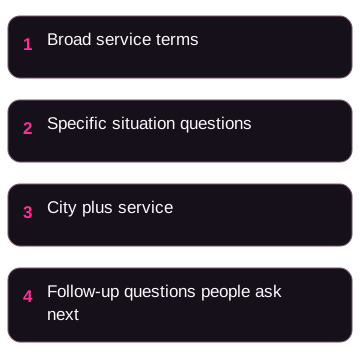
Look at four kinds of searches:
Broad service terms. Short phrases such as "financial advisor" or "retirement planning." Treat them as later targets, not week-one goals.
Specific situation questions. Longer phrases that name a real case: "fee-only financial advisor for doctors," "how to roll over a 403b to an IRA," "fiduciary planner for business owners." The person is closer to a decision. That does not mean they will hire you. It does mean the page can speak to a task they already have.
City plus service. "Financial advisor in Austin" or "retirement planning in Boston" matches how many local clients search. If you serve a metro, give that city its own page with real information, not a one-line mention in the footer.
Follow-up questions people ask next. Questions such as what a fee-only advisor charges, how to find a fiduciary, or whether hiring a planner is worth it. Answer the question in plain language near the top of the section. Do not hide it three paragraphs down.
You do not need a keyword-difficulty score to start. Write down the phrases your best-fit clients actually use, check which pages you already have, and fill the gaps. Once the site is connected, Google Search Console shows queries you already appear for.
Make each page clear before you worry about links
Search engines and people both need to tell what a page is about.
Title and description. Every page needs its own title. "Home | Smith Financial Advisors" tells nobody what you do. "Fee-only financial advisor in Denver | Smith Financial" matches a real search. The meta description is the short line under the title in search results. Write it as a clear line about what the page covers, not "Contact us today."
Do not treat character counts as ranking rules. Keep the title readable on a phone. If it gets cut off, shorten it.
One main heading. Use a single H1 that matches the page. Use H2s for the major sections and H3s for sub-points. Do not skip levels, and do not use headings as decoration.
Say the topic early. Name the service, city, or question in the first stretch of the page, in a sentence a person would actually read. Do not repeat a phrase to hit a density target. Stuffing keywords makes the page worse to read, and it is not a strategy.
Link your own pages to each other. A retirement planning service page should point to the articles that explain pieces of that work. An article should point back to the service page and to related posts. That helps a reader finish the job, and it helps search engines see which pages belong together. We cover the site structure that supports this in financial advisor website design that converts.
Fix the technical problems that hide your pages
If a page is slow, broken on a phone, or confusing to a crawler, good writing may never get a fair look.
Loading and interaction. Watch for uncompressed hero images and heavy scripts. Compress images, wait to load scripts the first screen does not need, and test the phone version, not only the desktop. Google's PageSpeed Insights and the Core Web Vitals report in Google Search Console show what lab tests and, when available, real-user data are hitting. Use the thresholds Google shows in those reports now, not a number remembered from an old article.
Phone layout. Check key pages on an actual phone. If buttons overlap or text runs off the screen, fix that.
Structured data. Schema.org markup can label your firm, an article, a person, or a list of questions in a machine-readable way. For an advisor site, consider LocalBusiness for the business and its locations, Person for advisor bios, and Article for posts. Choose a type only when it accurately describes the page. Structured data must match what is on the page. It does not guarantee a special search result, and it is not a ranking requirement.
Technical crawl issues, server time, and Core Web Vitals fixes are their own job. If you are not the person who can change the site's code, get someone who is.
If you serve a city, start with local search
If your practice is tied to a metro, local search is usually the part of SEO to get straight first. You still have to earn any map listing. Nobody is owed those results.
Three local pieces of work matter most.
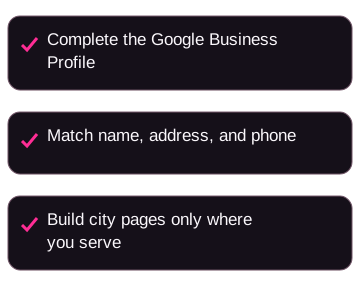
Google Business Profile. Fill in the legal business name (do not cram keywords into the name), address, phone, website, hours, service areas, and categories. Categories should match what you actually do. Write a business description that a person would read. Keep the profile complete, and post when you have something real to say, such as a change in hours or a useful article. Posts are not a ranking formula. A complete profile is necessary work for local visibility. It is not a placement guarantee.
Name, address, and phone must match. Use the same business name, address, and phone number on your site, your profile, and the directories you already belong to. "Suite 400" in one place and "#400" in another makes it harder to tell listings apart. If you are in NAPFA, XYPN, the CFP Board finder, BrokerCheck, or a local chamber directory, make those listings match too. You do not need a long list of new directories. You need the real ones to agree.
City pages only where you serve. A page for each city you actually work in should explain who you help there, how to reach you, and what the engagement looks like. An article that answers a local question, such as what hiring an advisor costs in that city, can name the place and the task at the same time. Only do this for cities you serve. Fake location pages waste time and confuse people.
Local search sits inside a wider client-getting picture. See lead generation for financial advisors for how discovery, follow-up, and meetings connect.
Write about the topics you actually help with
One isolated article rarely carries a whole topic. If retirement planning is a core service, you need a main page that covers the subject honestly, plus supporting articles on the questions inside it: Roth versus traditional accounts, required minimum distributions, Medicare timing, and so on. Each supporting article should link back to the main page, and the main page should link out to each supporting article.
That structure helps a reader. It also makes it clearer that you cover the subject on purpose. It is not a word-count contest. A short page that answers the question is more useful than a long page that repeats itself. Google has no preferred article length.
Write as often as you can do the work well and get compliance review. A calendar quota does not make thin posts useful. Under-researched posts, or posts published without a qualified person checking them, are a common way advisor blogs stall.
For how content fits a broader marketing plan, see wealth management marketing strategies. After a post is live, you can point to it from email when it is relevant. Email marketing for financial advisors covers that sequence.

Earn links the slow way
Other sites linking to you can still help people and search engines find your pages. Google's link-spam policy covers buying links for ranking purposes and excessive link exchanges. Do not do that.
Safer paths take more time:
- Contribute a useful article or a quoted comment to a publication your clients already read, such as Kitces.com, when they actually want that contribution.
- Keep credential directory profiles complete and pointed at the correct URL, if you hold those credentials.
- Talk to a local reporter or sponsor a local event only when the mention is real and your compliance reviewer is comfortable with it.
- Guest on a podcast whose audience matches the people you want to reach, and make sure the show notes URL is correct.
- If you later publish original research, say how you collected it. Do not invent a survey for this article, and do not treat a small informal poll as proof of a market.
A journalist query service can be one way reporters find sources. It does not guarantee a link or a client.
What changed with AI answers
Some searches now show an AI summary above the usual links. Some people ask ChatGPT, Claude, Perplexity, or similar tools a question they used to type into Google. Treat any percentage you see in a pitch as not independently confirmed until you check it yourself.
What you can control is the page:
- Answer the question in a few clear sentences before you expand.
- Name real things when they matter: a form, a tool, a regulator's page, a credential. Vague advice is harder to trust.
- Put a real author on the work: name, role, credentials they actually hold, and a bio page. Do not invent experience.
- If you want a given crawler to read your site, check robots.txt so you are not blocking it by accident. If you do not want a training crawler to use your pages, that is a separate choice. Have compliance weigh in, because public pages are still your marketing.
- An llms.txt file is an optional convention some sites use to point machines at key URLs. It is not required to appear in Google, and it does not make citation likely on its own.
Google applies the same SEO requirements to AI Overviews and AI Mode. A page must be indexed and eligible to appear with a snippet. There is no special AI file or schema you have to add. Google's AI search guidance explains the requirements.
For ChatGPT, OAI-SearchBot handles search and GPTBot handles model training. You can allow search while declining training. OpenAI's crawler documentation explains those separate settings. Allowing access does not guarantee a citation.
Do not add FAQ markup, speakable markup, or special AI files just to chase a ranking effect. If a FAQ is useful to a reader, write it on the page first.
AI tools can repeat your wording without your disclaimers sitting next to it. That is one more reason to keep public pages educational, avoid guarantee language, and run them through compliance.
Treat every page as marketing material
For many advisory firms, the website is marketing. Titles, meta descriptions, blog posts, and advisor bios can all be reviewed under your firm's policies. This article is not legal advice, and it does not make a page compliant.
Ask your compliance reviewer to look at:
- Any wording that sounds like a result, a guarantee, or typical client outcomes.
- Testimonials, reviews, and "top advisor" badges, including what you would need to disclose.
- Pages that pitch your services versus pages that only explain a topic.
- Anything an AI crawler could lift out of context.
When you are unsure, keep the article educational and put the service pitch on a page that already goes through your review process. For official marketing-rule materials, start at the SEC's investment adviser marketing page and follow your own counsel. Do not treat a blog summary as the rule.
Check whether the work is worth continuing
Set up Google Search Console before you judge the work. It shows queries, pages, clicks, impressions, and index issues. Check it on a regular cadence. A drop in clicks is a prompt to inspect the page, not proof that a competitor beat you.
Keep these numbers side by side:
- Organic visits, by page
- Queries that actually bring those visits
- Contact forms, calls, or booked meetings that came from organic pages
- Time your team spent writing, reviewing, and following up
- What you paid specialists or tools
Rankings alone are not the business outcome. A page in position three that brings no conversations is not a win.
Here is a made-up example so the arithmetic is visible. It is not a result from OJay or from any advisor firm.
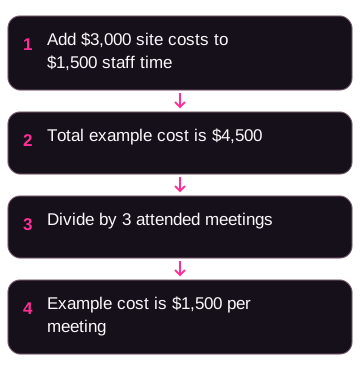
Suppose in one quarter you spend $3,000 on writers, tools, and site fixes, and your team spends 20 hours at $75 an hour. That is $1,500 in staff time. Total cost: $4,500. If you can tie that work to 3 meetings that actually happened, the example cost per meeting is $1,500. If one of those meetings became a client, the example cost to acquire that client is $4,500 before the cost of serving them. If none became clients, you have spent $4,500 without new fee revenue yet.
Do not turn a client's assets into your revenue, and do not treat revenue as profit. Use the same definitions every quarter. Attended meetings mean attended meetings.
How SEO and ads can sit side by side
SEO and Google Ads are not a contest. Ads can show you today while you wait to see whether a page earns any organic attention. If a search phrase brings qualified conversations in ads, that is a clue the topic may be worth a durable page. If organic pages start covering that phrase, you can later decide whether to keep paying for it.
Neither channel guarantees a lower cost per client. Compare them with the same meeting and client definitions. Details on the paid side live in Google Ads for financial advisors. The wider funnel sits in lead generation for financial advisors.
If you are comparing firms that would do this work for you, best marketing agency for financial advisors is a separate buying guide. OJay Media builds websites, ads, qualification questions, and follow-up for advisory firms, so we have a commercial interest when you look at hiring help. Use that guide on its own merits.
A few common questions
How long does SEO take for a financial advisor site?
It depends on the site you already have, the phrases you are targeting, and whether the pages are actually useful. Some long, specific questions can move sooner than a generic "financial advisor" term. A new domain with few references from other sites usually takes longer. There is no honest timeline that fits every firm, and a ranking in month four does not mean meetings will follow.
How much should I budget?
Ask for a written scope: which pages they will change, who writes versus who reviews for compliance, how many new or refreshed pages are in the first quarter, what you keep if you leave, and how they define a lead versus a meeting. Public "typical monthly retainers" on old blogs are not a quote. Compare the full cost, including your team's time, against the meetings you can actually trace. Do not use a cost-per-click rumor as the baseline.
How do I get cited by ChatGPT or Perplexity?
You cannot make those tools cite you. You can publish clear, accurate pages with a real author, keep crawlers you care about from being blocked by mistake, and answer questions directly. Citation, if it happens at all, follows whether the tool retrieved and trusted the page. Treat anyone who sells a guaranteed citation as selling something they cannot promise. If you check AI answers over time, record the prompt, product, date, and context. One answer is a spot check, not a full measure of your visibility.
Does blogging help an advisor site show up?
It can, when each post answers a search a real person would make, links to the related service page, and is accurate enough to survive compliance review. Generic posts that could sit on any firm's blog usually do not help much. Blogging is not required at a set monthly volume.
What to do this month
Pick one city or one specialty you actually serve. List the questions those people ask before they book a call. Fix the Google Business Profile if you are local. Give each important page a clear title and a next step that matches what you want someone to do, such as applying for a conversation. Connect Search Console. Then write or refresh the one page that answers the most useful question you do not currently cover.
If you want a second set of eyes on the site structure and follow-up around those pages, read how we describe the work on this site, then decide whether a conversation is useful. You can also start with the lead generation for financial advisors guide if you need the wider picture first.
OJay Media is a marketing agency for wealth advisors. This page is educational and is not investment, legal, or compliance advice. Advisors remain responsible for their own marketing review.