The best marketing agency for financial advisors is the one that can do the job you actually need, get work through your compliance review, and put the full cost in writing before you sign. There isn't a single shop that wins for every firm.
A polished pitch still leaves the hard parts unanswered: whether they understand your practice, who follows up after a lead arrives, and what happens when your reviewer asks for changes.
Use the same questions on every shop before you put money into any of them.
Key takeaways
- Hire for a defined job, not a vibe. A website rebuild, ongoing content, paid ads, and a software subscription are different purchases.
- Ask every shop the same questions about work with firms like yours, compliance review, price, reporting, and how you can leave.
- Get the full cost in writing, including ads, tools, and your team's time. Then divide by the meetings that actually happen.
- No agency can honestly promise new clients, revenue, or AUM. Treat those promises as a reason to slow down.
- OJay Media is a marketing agency for wealth advisors, so we have a commercial interest in this topic. Judge each shop on the same questions, including us.
What are you actually hiring?
Start with the job, not the logo.
You might need a website that explains who you help. You might need articles or ads so people can find you. You might need someone to run follow-up after a form fill. You might only need a writer for a defined set of pages. Those are different buys. A shop that is strong at one of them is not automatically strong at the others.
Be honest about what your team will still own. Someone at your firm will likely need to answer questions, join review calls, and talk to people who respond. Buying help does not create extra hours in the day.
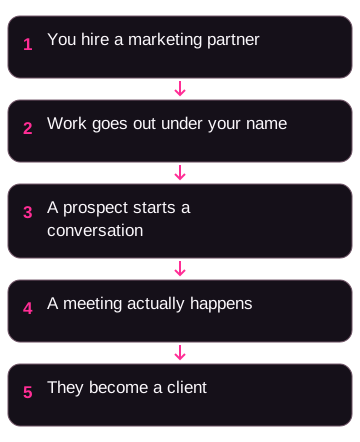
A signed contract is not a new client. That work still goes out under your firm's name. Work has to turn into a conversation, then a meeting that happens, then a client who chooses you. Track those steps separately so you are not paying for activity you cannot connect to a meeting.
Four kinds of shops you'll meet
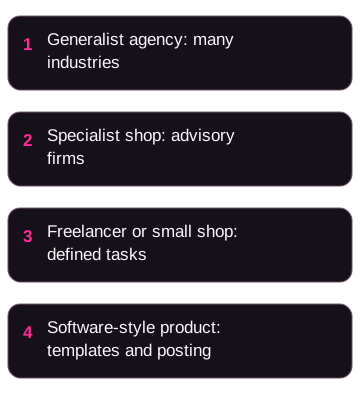
Not every company that says agency sells the same thing. These four buckets are a way to sort the pitch. They are not a census of the market, and a real firm can sit in more than one bucket. Ask which one matches the proposal in your inbox.
Generalist digital agencies
These shops serve many industries. They may be capable at ads, websites, or search. They may not know how advisory firms review marketing, or how long a high-net-worth prospect can take to decide.
Ask who reviews content before it goes live, and how many advisory firms they have served recently. If the answer is thin, you will be paying for their learning time.
Best fit when you already have a compliance reviewer who will check every piece, and you are buying a defined technical job.
Watch for copy that could sit on any company's site, and a plan that falls apart the first time your reviewer asks for changes.
Specialist shops
These firms say they work with RIAs, wealth managers, or other advisory practices. That can help with language and process. It is not a substitute for proof.
Ask for current examples of work for firms like yours, and for a walkthrough of how they handle review before publication. Then get a current proposal. Do not assume a specialist is more expensive, cheaper, faster, or safer until they show you the scope and the price.
Best fit when you want a partner who already knows this audience, and they can show relevant work.
Watch for a long contract and a high fee without a clear list of what you get each month.
Freelancers and small shops
A specialist writer, designer, or ads contractor can be the right buy when you already know the plan and need hands. You are usually buying a task, not someone to own the whole program.
Best fit when you can brief the work, review it, and handle the plan yourself.
Watch for no one watching the whole picture, and no one to run ads or reporting unless that is in the statement of work.
Software-style products
Some offers are closer to a subscription: content libraries, scheduled posts, email sequences, or a dashboard. They may call themselves an agency. Ask whether a person is doing work for your firm, or you are getting templates and software.
Best fit when you want a tool and you have time to adapt it.
Watch for material that does not sound like your practice, and a feed of posts that never turns into conversations.
When you hear names while you shop, treat them as a list to query, not a ranking. You may hear names such as Ficomm Partners, Paladin Digital, Beyond AUM, or SmartAsset AMP. This is not an endorsement, and I cannot honestly describe their current products, prices, or results from this page. Ask each one for a current written proposal that answers the same questions. Do not assume they all sell the same thing.
Five things to compare before you sign
You do not need a complicated scorecard. You need clear answers in writing.
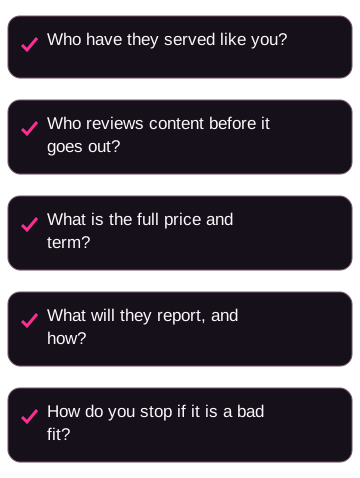
1. Have they served firms like yours?
Ask for examples you can verify: the type of firm, the work they did, and what they measured. "We had a financial client once" is a weak answer. You want to know whether they have done this job for advisory practices, not whether they can list your industry on a slide.
Ask what they will share publicly. Some firms cannot name clients. That is not automatically a no. It does mean you should press on the work sample, the reference call, and the definition of a qualified inquiry.
2. How does compliance review work?
OJay Media is a marketing agency. We are not your compliance department, and this article is not legal advice.
Your firm is responsible for the words that go out about your practice. Ask any shop:
- Who writes the first draft?
- Who on their team checks it?
- Who at your firm approves it before publication?
- What happens when your reviewer asks for changes?
- How do they handle testimonials, ratings, performance claims, and social posts if those are in the plan?
If they cannot describe a review path, you will either slow every piece down yourself or take a risk you did not mean to take. For current rules that apply to your registration, have your compliance reviewer use the primary material from the SEC and, if you work through a broker-dealer, from FINRA. Do not treat a marketing pitch as a legal opinion.
3. What is the full price, and what does it include?
Ask for the full cost in writing. A monthly number is not enough if ads, tools, landing pages, or extra writing sit outside it.
Compare:
- Monthly fee and what hours or deliverables it covers
- Ad spend, and who controls the accounts
- Setup fees, tools, and contractors
- Minimum term, renewal, and cancellation deadline
- What you keep if you leave: copy, creative, lists, ad accounts, analytics access
Some shops charge only a monthly fee. Some charge by the project. Some add a fee tied to a defined event, such as a booked meeting. None of those models guarantees a client. If they tie fees to a result, get the definition in writing. A form fill, a booked call, an attended meeting, and a signed client are four different things.
For a fuller look at how to budget this work, see financial advisor marketing cost.
4. What will they report?
Ask how they connect a campaign to a conversation and to a meeting that happened. If the sample report only shows impressions, clicks, or followers, you still do not know whether the spend is producing meetings.
Useful questions:
- How do you know which campaign a new inquiry came from?
- Can I see a sample report with the numbers you would show me each month?
- Do you track through to attended meetings, or do you stop at clicks?
Agree what qualified means before the first invoice. Use the same definitions for every shop you compare.
5. How do you stop if it is a bad fit?
Ask for the term, the cancellation notice, and any exit tied to missed work. A shop that will not put the scope and the stop rules in writing is asking you to trust a slide.
No honest shop can guarantee AUM, revenue, or new clients. You can still ask for a short pilot, a review date, and a written list of what they will deliver by that date. Get that in the agreement, not in the pitch.
Walk away when the answers stay vague
You do not need a dramatic story to justify caution. These patterns are enough:
- They cannot show work for advisory firms, and they cannot explain how they would learn your practice without using you as the test case.
- They have no described path for compliance review, or they treat it as your problem after they hit publish.
- They lead with follower counts and brand awareness and cannot say what a meeting costs.
- The contract is long, the scope is fuzzy, and there is no clean way to stop.
- They promise search results in a few weeks, or they promise AUM growth. That is a sales line, not a plan.
One weak answer is a reason to ask again. Several weak answers are a reason to keep shopping.
A simple way to score two proposals
Here is a worksheet you can copy. The weights are a starting point, not a study. Change them if one issue matters more to your firm.
| What you are scoring | Suggested weight | What a high score looks like | What a low score looks like |
|---|---|---|---|
| Work with firms like yours | 25% | Current work samples and a reference you can call | No relevant examples |
| Review before publication | 25% | A named process, including your approver | They have not thought about it |
| Price and term | 20% | Full cost, clear definitions, term you can live with | Vague monthly number, long lock-in |
| Reporting | 15% | Sample report from inquiry to attended meeting | Traffic and impressions only |
| Ability to stop or reset | 15% | Written pilot or exit terms | No way out if the work misses |
Score each row from 1 to 5, multiply by the weight, and add them up. Use the same sheet for every shop.
If review before publication scores a 1 or 2, do not average that away. You would be hiring someone who cannot describe how your materials get approved.
This sheet does not pick the winner for you. It keeps two proposals on the same page so you are not comparing a website quote with a lead program and calling them the same thing.
Check the fit over four weeks
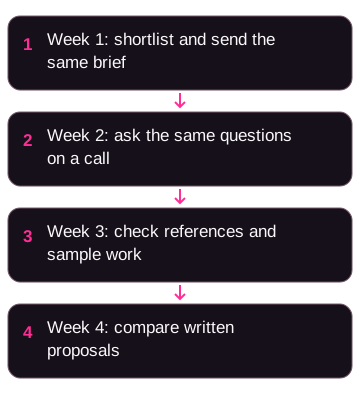
Before you sign, spend a few weeks comparing people, not logos. This sequence is a suggestion. Stretch it if you need to.
Week 1: Shortlist and send one brief.
Pick a handful of shops from peer referrals, your professional associations, and search. Send each the same one-page brief: who you help, where you work, what you already do for marketing, what you want help with, and a budget range. Ask for a one-page approach and an example of similar work.
Week 2: Run the same call.
Use the five questions above. Take notes. Do not let a charismatic pitch skip the parts they cannot answer.
Week 3: Check references and a work sample.
Ask for people you can call at advisory firms. Ask those people about review, communication, and whether they would hire the shop again. Ask the agency for a short sample: a content outline or an ad concept for your actual practice. You are looking at how they think, not asking for free finished campaigns.
Week 4: Read the proposal like a contract.
Line up scope, price, term, reporting, and exit language. If two quotes still are not comparable, ask them to recast the numbers for the same three months and the same deliverables.
This process costs time. Signing the wrong shop also costs time, plus fees, plus a calendar you cannot get back. There is no guaranteed dollar amount for a bad hire. The point is to see the mismatch before it starts.
What the work usually includes
A useful partner should be able to explain which of these they will do, which they will not, and who at your firm still owns each step.
Pages and search.
They should know which questions your ideal clients actually ask, then build pages that answer those questions in your voice. For the broader program around that work, see wealth management marketing strategies.
Paid ads.
If ads are in the plan, ask which queries or audiences they would start with, who owns the ad account, and how they will pause spend that is not leading to conversations. See Google Ads for financial advisors and Facebook Ads for financial advisors.
LinkedIn.
If you want to reach owners, executives, or people approaching retirement, ask whether they mean your personal profile, a company page, ads, or all three. See LinkedIn for financial advisors.
Inquiries and follow-up.
From the first click or form to a booked conversation, someone has to qualify, reply, and follow up when people go quiet. See lead generation for financial advisors.
The website itself.
Traffic that cannot book a conversation is expensive. Ask how they would change the page a stranger sees first, what questions they would ask before a call, and how they would reduce friction in booking. See financial advisor website design that converts.
None of those channels has a guaranteed timeline or a guaranteed result. Paid ads can produce inquiries sooner than a new article. An article can keep working after you stop paying for a click. Either way, you still need follow-up, and you still need meetings that happen.
If a shop promises search rankings in 30 days, or new AUM on a calendar, ask them to put the exact promise in the contract. Most will not. That is useful information.
Look at the full cost, not just the monthly fee
A lower monthly number can cost more if your team spends nights chasing people who never meet, or if ads sit outside the quote.
Count the money you pay the shop, the money you pay the platforms, and the time your team spends. Then divide that total by the meetings that actually happened. Keep going to clients only after you have that meeting number. Do not turn AUM into a revenue guess unless you already know your own fees and costs.
Here is the math with made-up numbers.
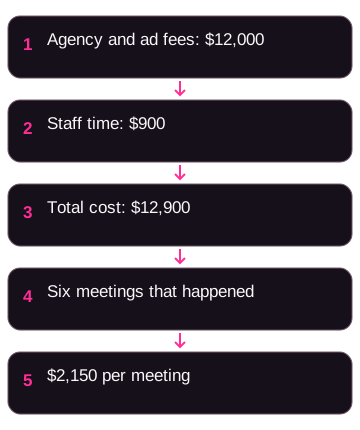
Suppose three months of agency fees and ad spend come to $12,000. Your team spends 18 hours on reviews and follow-up at $50 an hour. That is $900. Total: $12,900.
If six meetings actually happened, that example is $2,150 per meeting. $12,900 divided by 6 equals $2,150.
These are invented figures, not a typical price and not a result from OJay or any other shop. For this example, the $12,000 includes every vendor invoice for the period. The $50 hourly rate is an assumption so you can see the staff-time line. Your numbers will differ.
Then ask the next questions with your own data. How many of those meetings became clients? If one client signed in this example, the acquisition cost is still $12,900 for that period. If nobody signed, you spent $12,900 without a new client yet. The cost per meeting cannot tell you whether the spend paid off.
Use the same clock for every quote. Three months of Shop A versus one month of Shop B is not a comparison.
What if you want people coming directly to your firm?
Buying help from an agency is one path. Another is to build a way for people to find your firm, learn why they might work with you, and apply for a conversation, under your name.
That is the work we do at OJay Media. We build the website pages, ads, qualification questions, and follow-up around your firm.
The aim is for someone to understand what you do before they speak with you. Building this still takes time, money, testing, and follow-up. You can compare that investment with hiring another kind of shop, or use both. What matters is knowing what you own, what you are paying for, and whether it brings in clients at a cost your business can support.
OJay Media offers this kind of marketing service for wealth advisors, so we have a commercial interest here. We are one option in the same evaluation. Use the same questions on us that you use on everyone else.
Want to see how we'd build this around your firm?
See how our process works, then decide whether a conversation makes sense. You can schedule a Growth Advisory Call or apply to work with OJay.
A few common questions
What is the best marketing agency for financial advisors?
There isn't a single best shop. Look for a partner that can show work with firms like yours, explain how materials get through your compliance review, put the full price and term in writing, and report from inquiry to attended meeting. Specialist firms and smaller shops can both be the right fit. So can a freelancer, if you only need a defined task. Get a current proposal from each name you are considering, including OJay Media, and score them on the same sheet.
Do I need a shop that specializes in financial services?
Often that helps, because your reviewer will ask questions a generalist may not expect, and your prospects may take longer to decide than a typical online buyer. It is not an automatic yes. A specialist with a vague proposal can still be a bad hire. A generalist with a tight scope, a named reviewer, and relevant work can still be useful. Ask them to show the path, then have your compliance person sign off on the materials.
How much should I budget?
I cannot give you a real average from this page, and public typical retainers are easy to get wrong. Ask each shop for a written quote that separates their fee, ad spend, tools, and term. Then add your team's time. Compare three-month totals, not just the monthly line. Our marketing cost guide walks through how to structure that budget.
How long before I should expect meetings?
It depends on the channel, your offer, your follow-up, and the contract you signed. Paid ads can produce inquiries sooner than new articles. New articles can take longer to show up in search. None of that is a guarantee. Agree on a budget and a review date before you start. A few quiet days are not enough to judge the whole engagement, and a promise of fast AUM is not a plan.
What should I ask on the first sales call?
Ask them to walk through one piece of work from brief to published to inquiry to meeting. Who writes it? Who approves it? What do you receive each month? What is the full cost? What happens when a lead is a duplicate or a page needs a rewrite? Then ask for a reference at an advisory firm.
- Wealth management marketing strategies
- How to attract high-net-worth clients
- Lead generation for financial advisors
- Financial advisor marketing cost
OJay Media is a marketing agency for wealth advisors. This article is educational. It is not investment, legal, or compliance advice. You remain responsible for reviewing your own materials with your compliance process before they go out.