A wealth management marketing strategy is the order of decisions you make before you spend: why they would pick you, who you want as clients, what you say in public, and which channels you use. If those are not written down, you do not have a strategy. You have posts, ads, and referral asks that do not add up.
This page is a working guide for advisor firms. It is marketing advice for your business, not advice to investors. Have your compliance reviewer approve anything you publish.
Key takeaways
- Write the strategy before you buy ads or post more often. Channel spend cannot fix unclear positioning.
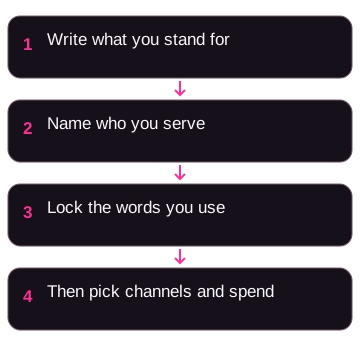
- Make four decisions in order: what you stand for, who you serve, the words you use everywhere, then where you show up.
- A narrower audience is a commercial choice. Check that there are enough people, that they can hire you, and that you can actually reach them.
- Keep website copy, LinkedIn, emails, and your first meeting script on the same claim. Mixed wording makes you harder to remember.
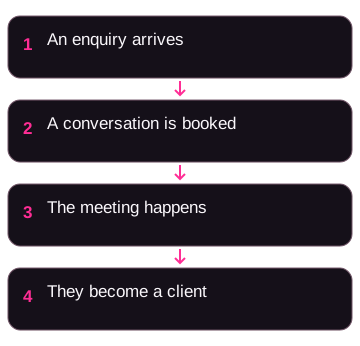
- Track enquiries, booked conversations, meetings that happen, and new clients separately. Then look at total cost per new client. Impressions are not that number.
- Give the plan a review date you can live with. A few quiet weeks is not enough to judge it.
Start with four decisions, in order
Suppose you start with a channel because a peer said LinkedIn worked, or you run ads after assets dip. If the offer and audience are unclear, the results will be hard to interpret.
The order is the strategy.
First, say why a specific person would choose you instead of another qualified firm nearby. That is positioning, not a list of services. Plenty of firms offer planning, investment management, and tax coordination. A service list is not a reason to pick you.
Second, name the people you want. Positioning is what you stand for. Niche is who you stand for. They should match.
Third, write the sentences you will reuse: the one-line claim, why someone should believe it, the hesitations you will answer in public, and the words your audience already uses.
Fourth, pick channels and a budget. Those choices get easier once you know who you are talking to and what you are allowed to say.
Do not spend on ads to see what happens while those first three are still vague. You will not know whether the channel failed or the message did.
Decide what you stand for
Ask this in the prospect's shoes: why would I talk to this firm instead of the other credible option I already have?
If the answer is we do comprehensive planning, you have not finished. That is what you sell, not why you are the firm for a particular person.
Three ways to make the choice clearer:
By the people you serve. You work with a defined group. Examples: owners of dental practices, software employees with concentrated company stock, or people navigating a divorce later in life. Specific is easier to remember than families and executives.
By the problem you take on. You are known for one job. Examples: helping a practice owner prepare the financial side of a sale, helping someone turn a concentrated stock position into a plan they can live with, or helping a family think through inherited wealth. The job is the position.
By how you work. A different fee structure, a stated response-time standard, or a yearly review format can help. Explain why that way of working matters to the client you want. Use method only if it is real and you will keep it.
A smaller firm that is easy to recognize for one group can be the obvious call for that group, even if a larger generalist is nearby. That is a positioning bet, not a promise that you will win every time.
A useful test: name three firms a prospect might also consider. Write one sentence for each about why a specific person would choose you. If you cannot finish those sentences, fix that before you buy traffic.
Do not claim specialist results you have not earned. Do not publish client stories or outcome numbers unless your compliance reviewer has approved the exact wording.
Choose who you serve
You might worry that a narrow focus leaves money on the table. The other side is simpler: if you try to speak to every household above a modest asset line, you give each reader less help deciding whether the service is for them.
A narrower niche is not automatically smarter. It is only useful if you can meet the people in it and they can become clients your firm is built to serve.
Run three checks before you commit:
Can you reach enough of them? There has to be a population you can get in front of, locally or remotely, through associations, publications, search, LinkedIn, or professional partners.
Can they hire you at your minimums? If your firm is built for a certain asset level or complexity, the niche has to contain people who can look like that. A passionate audience that cannot hire you is a hobby.
Is there a realistic path to them? Job titles, associations, specialist accountants, and search queries you can name are useful. We will figure out distribution later is not.
Use all three checks. If fit or access is weak, pick a different group rather than spending a year on content that the people you can actually serve will never see.
A client can refer you more easily when they can say who you help in one sentence. That is ordinary referral logic, not a guarantee that referrals will arrive. The referral marketing guide for wealth managers on this site goes into the mechanics.
If you plan to use community proof, testimonials, or endorsements, stop and get a compliance review before you build that into the plan. This article does not tell you what any marketing rule allows.

Get every public sentence saying the same thing
Once you know who you are for, write the language down. Then put it on the website, the LinkedIn about section, the email signature, the one-pager, and the opening of a first meeting.
If those surfaces disagree, people notice even if they cannot name it. They hear three slightly different firms.
Write these five parts:
1. The core claim. One sentence with the people and the job. Example: We help orthopedic surgeons plan for a practice sale in the decade before they exit. That is an illustration of specificity, not a client case and not a result.
2. Three reasons to believe it. Each reason needs something a prospect can inspect: a process, a credential, a type of work you actually do. We care about your goals is not a reason.
3. The hesitations you will answer in public. Common ones: do you understand my situation, how do you charge, how are you different from my current advisor. Put clear answers on the site so the first call is not a decoding session.
4. Proof you are allowed to show. Credentials, years of focus on this group, anonymized examples your reviewer has approved, media you can actually point to. Do not invent case studies. Do not imply results.
5. Their words, not internal jargon. Managing the cash from selling the practice lands better than post-liquidity event planning if that is how they talk.
Read your homepage out loud. If a person in your niche would not say it that way, rewrite it.
Choose channels after you know who you're talking to
Channel choice follows the niche. It does not follow whatever a competitor posted this month.
Consider five ways to meet prospective clients, each with a different job:
Referrals from clients and other professionals. An introduction gives you a person to follow up with and someone to ask for context. The work is a repeatable way to stay useful to clients, CPAs, estate attorneys, and others who already serve the same people. Not a gimmick program. The how to get clients as a wealth manager guide walks through these paths in more detail.
Search and useful articles. Slow to start. The bet is that people in your niche are already asking questions you can answer under your name. Structure those pages so a right-fit reader can ask for a conversation. See lead generation for financial advisors.
LinkedIn. Useful when your buyers and partners actually spend time there. Use posts to become familiar, then follow up on real interest. Details: LinkedIn for financial advisors.
Paid ads. The fastest way to buy attention. Speed is not the same as a predictable pipeline. Creative, targeting, the offer, follow-up, and the contract all change the cost. Ask any vendor for a current written quote, what you own, and what happens when a lead does not pick up. No ad system guarantees clients.
Introductions from specialist partners. Accountants, attorneys, and deal advisors who already serve your niche can describe you cleanly once your position is specific. That still takes relationship time. It is not a switch you flip in a week.
A made-up monthly split, so you can see the shape
There is no official right mix. Here is an invented example for a firm setting aside $5,000 in a month, after the first three decisions are written down:
- Paid attention: $2,500
- Articles and site work: $1,250
- LinkedIn tools and content time: $750
- Referral support (events, notes, partner time): $500
Those four numbers add up to $5,000. They are not a recommended mix, a typical RIA budget, or a forecast. If the wording is still generic, spend the next month on that instead of buying clicks.
Write your own split from where your buyers actually are, what your team can follow up on, and what you can keep funding until the review date.
A 90-day sequence you can actually run
A plan on paper does nothing. Ninety days is long enough to install the order above without pretending everything is finished.
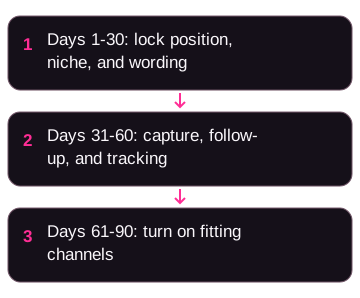
Days 1 to 30: foundation. Finish the positioning sentences. Pick one primary niche. You can add a second later. Draft the public language. Then audit the website, LinkedIn bio, email signature, and any pitch deck, and make them match. This month feels slow. It is the month that makes later spend easier to judge.
Days 31 to 60: infrastructure. Decide how a right-fit person asks for a conversation. For many firms that is a page, a few qualification questions, and a simple follow-up sequence. Set up tracking so you can count enquiries, bookings, and meetings that happen. If you test ads, keep the first spend small enough that a failed test is tolerable. That is a risk limit, not a bid recipe.
Days 61 to 90: activation. Turn on the channels that match the niche. Publish at a pace you can keep, not a quota you will abandon. Start honest outreach to professional partners who already serve the same people. Review the ad test before you raise spend.
At day 90 you should have a written position, matching public copy, a way to capture interest, and a first read on which channel produced conversations. You should not expect a set number of new clients. That would be a guess.
Track the numbers that change the next spend
Website visits, impressions, and follower counts are easy to screenshot. They do not tell you whether marketing is feeding the firm.
Count four things, with the same definitions every month:
1. An enquiry arrives. Someone asked for help: a form, a call, an email, or a referred introduction you can name. If you are buying attention, also keep what you paid per enquiry.
2. A conversation is booked. What share of enquiries put a meeting on the calendar.
3. The meeting happens. Count people who actually attend. A no-show is not a meeting.
4. They become a client. What share of completed conversations become clients, and whether those people match the niche you said you wanted.
Use the same labels for every channel. Otherwise you will compare a cheap enquiry from one source with an attended meeting from another and call it a test.
Look at what a new client actually cost you
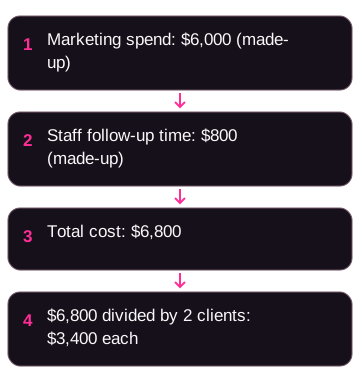
Add what you paid vendors and ads to what your team's follow-up time cost you. Divide by new clients in that period. If nobody became a client, the cost is the full spend and you do not yet have a client-level number.
Do not turn assets under management into revenue or profit in this math. Cost per client is a marketing number. What you later earn from a client is a separate question your finance lead can model with real fees and real costs to serve.
Here is a made-up example.
Assume $6,000 in marketing spend in a quarter and $800 of staff time spent following up. That is $6,800 in total. If two people became clients, the example cost is $3,400 per client. If zero became clients, you spent $6,800 and you do not have a cost-per-client figure yet, only a cost with no new client.
Those dollar amounts are invented. They are not OJay results, industry averages, or a target.
Then ask the slower questions: how long from first conversation to signed client, and whether the people who signed are the people you meant to attract. A low cost per meeting is not a win if the meetings are with people you cannot help.
What changes when you want wealthier prospects
People with more to invest can take longer. They may read more, ask other people, and skip booking from a single ad. Plan for several useful touches, not one clever offer. The how to attract high-net-worth clients guide goes deeper on that audience.
A few practical shifts:
Time. Your follow-up has to survive a long gap between first visit and first call.
Trust before a pitch. Commentary, clear examples of who you help, and introductions from people they already trust often fit better than a loud download. That is a judgment call for your audience, not a law.
Selective positioning. A plain statement of who you take on, and who you do not, is often clearer than we would love to work with everyone. Only say it if it is true.
None of that guarantees a higher close rate. It changes how you judge a quiet month.
Stay with it long enough to judge it
Search pages you write this quarter may not matter for a long time. Partner introductions you start now may show up next year. LinkedIn familiarity builds on repetition.
If you change the niche, the claim, and the channel every 60 days, you will never know what to keep. A durable plan is one you would not be embarrassed to still be running in a year, with small tests inside it. A plan that needs a full rewrite every quarter is a stack of tactics.
Set the review date when you set the budget. Look at the four counts, not your mood after a bad week.
OJay Media is a marketing agency for wealth advisors. We have a commercial interest if you hire us to build pages, ads, and follow-up around your firm. This guide still has to be useful if you never speak with us. Do the four decisions on paper this week. That is the next step either way.
A few common questions
How much should a wealth manager spend on marketing?
There is no universal percentage that is safe or correct. Pick an amount you can keep funding until the review date you already chose. Then judge it by cost per new client, whether those clients match the niche, and whether your team actually followed up. A budget you abandon in six weeks cannot teach you much.
How long before I can tell if it is working?
Different channels move at different speeds. Paid attention can produce conversations sooner than a new article. Partner introductions often take longer. Agree on a budget and a review date before you start, and read the minimum term if a vendor is involved. A handful of unanswered calls is not a full test.
Do I need a marketing agency, or can I do this myself?
You should own the positioning, the niche, and the sentences, even if someone else helps execute. Writing, ads, and design take hours every week. Whether that is you, an internal hire, or an agency depends on time and skill, not on a rule. OJay Media does this work for advisor firms, so we are not a neutral referee if you are choosing a vendor.
What is the most expensive mistake?
Buying ads, or posting daily, before you can say who you help and why they would pick you. You will get activity that does not convert, then blame the channel.
How do I market without creating a compliance problem?
Do not treat this article as a reading of SEC or FINRA rules. Stay factual in your own drafts, do not promise results, and have your firm's compliance reviewer approve materials before they go live. Your reviewer should check current official SEC staff materials on the investment adviser marketing rule. When something is unclear, wait.