A review score cannot tell you whether Apex Acquisition or Advisor Jetpack will produce meetings your team can close.
Both companies sell help growing an advisory practice. The useful comparison is the proposal and the contract: how a booked meeting is defined, whether ads sit inside the fee, what the refund rules exclude, and what you keep if you cancel. This page is a working comparison, not a test of either company. OJay Media also sells marketing to financial advisors, so we have a commercial interest here. Verify current terms with each provider before you spend.
A review score isn't a result
If you're reading Apex Acquisition reviews, or Advisor Jetpack reviews, the useful question isn't whether the score is high. It is whether this company's offer, contract, and workload fit your firm.
A review can tell you that someone liked the coaching, or that someone felt they had to do a lot of the work themselves. It cannot tell you what will happen in your pipeline.
Keep four piles of notes:
- What the company says it does.
- What the agreement, pricing schedule, and refund language actually say.
- What reviewers report.
- What your team confirms on a sales call, in writing, and with your compliance reviewer.
A sales page is not a contract. A contract is not an audit of results. A review is not a typical-result study.
Here's a made-up example. An RIA gets a proposal that lists a monthly fee and says the program includes appointments. The proposal doesn't say whether the person has to show up, whether a duplicate counts, who pays for ads, or what happens if the prospect is outside the firm's market.
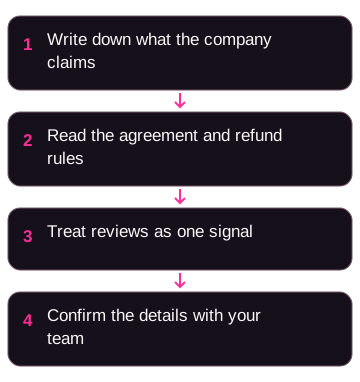
Using the four piles above, that firm would write down the vendor's wording, request the agreement and refund rules, read public reviews as one signal, and have the sales owner plus compliance reviewer test the definitions against how the firm actually works. That sequence is a way to review a proposal. It is not a client result.
What are you actually buying?
Start with the service itself. It makes little sense to compare two prices if one includes advertising, appointment setting, training, and software, and the other doesn't.
Apex Acquisition's public home page currently talks about booked calendar appointments, not a list of names to dial. Its public terms of service currently list targeted online advertising, lead generation funnels, appointment setting, sales training, and CRM access among the services. Ask Apex to walk you through one prospect from the first ad or form to the information you receive, then to the meeting. Ask which of those items are in your quote, and which cost extra.
Advisor Jetpack's public site currently describes a broader growth program: positioning, campaigns, and a dedicated advisor coach. It also describes training before launch, and says you can be up and running in as little as 48-72 hours depending on how quickly you go through that training. Ask whether the quote is a full growth program, what training you have to complete before launch, and how long launch takes once your firm has done its part. Don't treat a marketing line about a fast launch as a guarantee that your campaign will start on a set date.
Then have both companies show you what happens when the person doesn't answer, cancels, or isn't a fit.
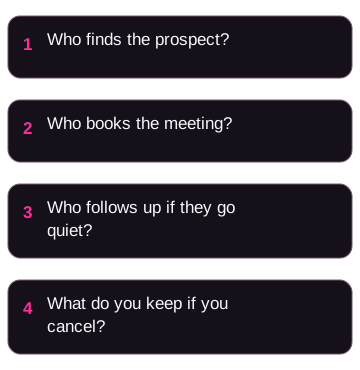
Who finds the person? Who books the meeting? Who follows up when they go quiet? Who owns the list if you leave?
If the answers are vague, you're not ready to compare price.
For more on how advisors buy leads and meetings, see lead generation for financial advisors.
What do Apex Acquisition and Advisor Jetpack cost?
Get a current written quote from both.
You need the full cost and commitment before you can make a useful comparison. This page does not list a public price for either company, and it doesn't fill the gap with industry averages.
Both companies' public sites currently say they do not charge per lead or per appointment. Ask how they actually charge in your quote. Don't assume the public wording is the invoice. Ask whether ads sit inside the fee or on top of it.
Ask each provider to put these items in writing:
| Cost or control question | Apex Acquisition | Advisor Jetpack |
|---|---|---|
| Setup fee | Request in writing | Request in writing |
| Monthly service fee | Request in writing | Request in writing |
| Required advertising spend | Request in writing | Request in writing |
| Minimum term | Request in writing | Request in writing |
| Renewal and cancellation notice | Request in writing | Request in writing |
| Refund window and exclusions | Request in writing | Request in writing |
| CRM, training, and community access after you cancel | Request in writing | Request in writing |
| Compliance revision or production fees | Request in writing | Request in writing |
| Charges outside the initial quote | Request in writing | Request in writing |
| Who owns the prospect data, ads account, pages, and domain | Request in writing | Request in writing |
Ask what you still have after you cancel: the prospect list, the CRM records, the ads account, the pages, and any training portal. If you can't export the data you paid to generate, that changes the real cost.
Apex Acquisition's public terms currently describe a 90-day initial term that starts when ad campaigns launch, then month-to-month cancellation in writing. They also say CRM, training, and community access are removed on cancel. Advisor Jetpack's public site currently says you keep full ownership of your database. Ask whether your signed agreement matches those public pages, including ads accounts, pages, domains, and export rights.
For broader budgeting context, see financial advisor marketing cost.
Look at what a meeting costs you
A cheaper-looking program can get expensive if your team spends hours chasing people who never meet with you.
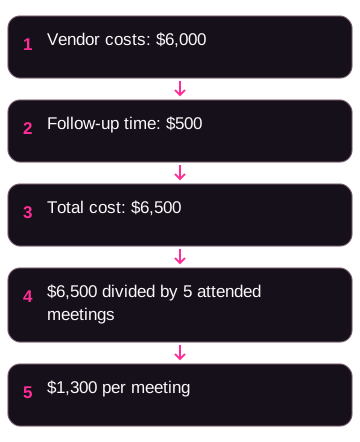
Count the money you spend on the service and the time your team spends following up. Then divide that total by the meetings that actually happened.
Here's a walkthrough with your own ledger, so you can see why a cheap-looking program can mislead.
Line up the written proposal for the period you're reviewing. Sum the vendor lines from that proposal. Sum the staff time your team spent following up, using your own internal rate.
Divide that total by the attended meetings you counted under one written definition.
These steps use your figures, not either company's prices or results.
Do not copy dollar amounts from this page. Public pages change. Use the numbers your firm can verify.
The cost per meeting alone can't tell you whether the spend paid off. Keep using the same definitions for both companies.
Use the same definitions for both companies. Count attended meetings the same way, include the same types of costs, and allow for the time between a first call and a signed client. Otherwise you're comparing two different things.
Don't convert assets under management into revenue, or revenue into profit, unless your own books support that step. Use the fees your firm actually collects, minus the cost of serving the client.
Complaints, refunds, and bad contacts
A negative review is one customer's account unless you have separate evidence. A tight refund clause is a contract fact, not automatically a scandal. Repeated review themes are a reason to ask better questions, not proof that a company always fails.
Apex Acquisition's public terms currently say refunds may be processed only before services begin (within 48 hours of the kickoff call), or if compliance policies prevent campaign launch. They also say no refunds apply once campaigns have begun. Ask whether your signed agreement matches that page, including duplicates, no-shows, and poor-fit prospects.
Ask Apex Acquisition to define, in writing, what counts as qualified, booked, attended, and credited toward any appointment commitment. Ask how duplicates, poor-fit prospects, cancellations, and no-shows are handled. If the sales conversation mentions appointments, show rates, close rates, or assets, ask for the definitions, time period, who is counted, who is left out, and whether those figures appear in the contract.
Ask Advisor Jetpack to define any lead or appointment commitment, any minimum asset threshold, what happens with no-shows, and whether service fees continue when your team's follow-up or close rate is the bottleneck.
Don't call either company a scam, or call the program compliant, based on reviews alone.
Have your own compliance reviewer check provider claims, testimonials, landing pages, emails, and follow-up copy before you use them. A vendor saying the program is easy on compliance is not your firm's approval. This is a marketing purchase for your firm, not advice to investors, and it still needs your reviewer.
Booked meetings, ads, refunds, and what you keep
For this comparison, get these answers in writing.
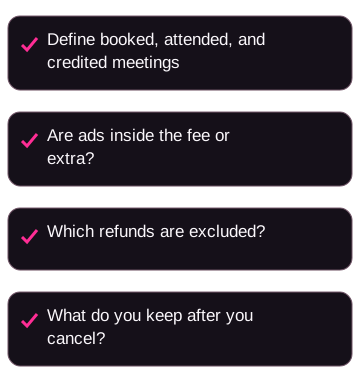
How is a meeting counted? Define booked, attended, and credited meetings. Ask how duplicates, cancellations, no-shows, and poor-fit prospects are handled.
Are ads inside the fee? Ask whether advertising spend sits inside the monthly fee or on top of it, and who owns the ads account.
What refunds are excluded? Get the refund window, the exclusions, and whether a no-show still counts against any commitment.
What do you keep after you cancel? Confirm the prospect list, CRM records, ads account, pages, domain, and training access. Ask what is removed the day you cancel.
If the answers are vague, ask for specifics before you sign. An unclear answer doesn't become clearer once the invoice arrives.
Match the proposal to the work you need
Look more closely at Apex Acquisition if the proposal is built around getting meetings on the calendar and you want to see coaching tied to that work. Ask for a walkthrough using the kind of prospect you want. Confirm the appointment definitions, the term, refunds, and what you keep if you leave.
Look more closely at Advisor Jetpack if you want a broader growth program and you're ready to spend time in training and follow-up. Confirm how they charge, how long you have to stay, who owns the database, and what launch depends on from your side.
If nobody has time to follow up, fix that first. Buying more names or more booked slots doesn't give your team more hours in the day.
These are starting points for your decision. We haven't run a head-to-head test of the two services, so I can't honestly tell you one will produce better clients for your firm.
For a wider look at how advisors choose a marketing partner, see best marketing agency for financial advisors. This page stays on Apex Acquisition versus Advisor Jetpack. Advisor Jetpack vs SmartAsset is a different comparison.
What if you want people coming directly to your firm?
There's another option worth understanding: build a way for prospects to find your firm, learn why they might work with you, and apply for a conversation.
That's what we work on at OJay Media. We build the website pages, ads, qualification questions, and follow-up around your firm, under your name. Building this still takes time, money, testing, and follow-up. It isn't the same product as buying a growth program from Apex Acquisition or Advisor Jetpack.
You can compare that investment with either vendor, or use both. What matters is knowing what you own, what you're paying for, and whether it brings in clients at a cost your business can support.
OJay Media offers this kind of marketing service, so we have a commercial interest in this alternative.
If you want to see how we'd build this around your firm, schedule a Growth Advisory Call or apply to work with OJay.
A few common questions
Are Apex Acquisition reviews proof that Apex will produce results?
No. A review rating and individual customer accounts show what a platform displays and what reviewers report. They don't prove typical lead quality, conversion, asset growth, revenue, or future performance. Request definitions, contract terms, and evidence that matches how your firm actually sells.
Does either company publish a fixed price I can use to decide?
Not on this page. Don't fill the gap with a guessed range. Ask both companies for a current written proposal, including ads, setup, term, refunds, and anything billed outside the monthly fee.
Can I just compare the price per lead or per appointment?
Use it as one part of the comparison only if that's actually how you're billed. Include membership or monthly fees, advertising, follow-up time, and the number of meetings that actually happen. Then track how many people become clients.
What should I ask about complaints?
Ask whether the concern is tied to a contract clause, a specific customer account, a recurring review theme, or a record your firm can inspect. Then ask the provider for its response and the remedy in the agreement. Don't label a provider fraudulent based only on negative reviews.
Which provider is better for a financial advisor?
This article doesn't support a universal winner. Compare service scope, total cost, contract terms, advisor effort, data ownership, compliance review, and the definitions behind any meeting or lead commitment.
More comparisons for financial advisors
- Advisor Jetpack vs SmartAsset
- Lead generation for financial advisors
- Financial advisor marketing cost